
Hyderabad has become one of the most popular destinations for students, fresh graduates, and working professionals who want to build or improve their careers in the technology industry. With opportunities across software development, cloud computing, data science, artificial intelligence, cybersecurity, testing, DevOps, and other IT domains, learning the right technical skills can make a significant difference in a person’s career journey.
For many learners, joining a Software Training Institute in Hyderabad is one of the first steps toward developing practical technology skills. While colleges provide academic knowledge, professional training programs can help learners understand industry tools, programming languages, development practices, and project-based workflows.
However, choosing a training institute is not always easy.
There are many courses, technologies, training providers, online programs, classroom options, and career-focused learning platforms available. One institute may specialize in programming, another may focus on cloud technologies, while another may offer courses in artificial intelligence, data analytics, testing, or full-stack development.
The right choice depends on your background, career goals, learning style, and the type of technology you want to learn.
This guide explains what to look for when choosing software training in Hyderabad, popular courses to consider, the benefits of practical learning, and how a structured training program can help you prepare for the IT industry.
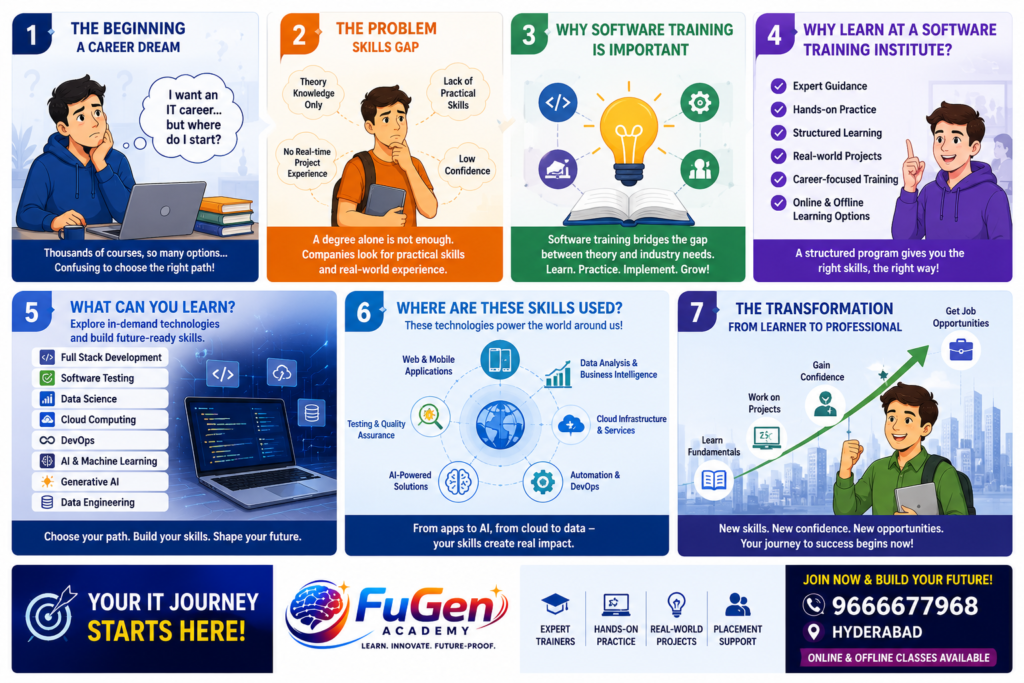
Why Is Hyderabad a Popular Destination for Software Training?
Hyderabad has a strong technology ecosystem and is home to numerous IT companies, startups, global organizations, and technology professionals.
Areas such as Ameerpet, Madhapur, Hitech City, Kukatpally, and surrounding technology corridors have become familiar locations for technical education and professional training. Current listings show software and IT training providers operating across several of these areas, offering courses ranging from programming and full-stack development to cloud computing, data science, AI, and cybersecurity.
This environment makes Hyderabad an attractive place for people who want to learn software skills.
Students can choose classroom-based programs, while working professionals can often find weekend, evening, or online learning options.
The growth of new technologies has also expanded the number of skills that learners can explore.
Instead of focusing only on traditional programming languages, students can now choose from areas such as:
- Full Stack Development
- Python
- Java
- Data Science
- Artificial Intelligence
- Generative AI
- Machine Learning
- Cloud Computing
- DevOps
- Cybersecurity
- Software Testing
- Data Analytics
- Business Intelligence
- Mobile Application Development
This variety is useful, but it can also make the decision more complicated.
What Is a Software Training Institute?
A software training institute provides structured learning programs designed to help students and professionals develop technical skills.
Depending on the institute and course, training may include programming fundamentals, software development tools, databases, cloud platforms, testing frameworks, development methodologies, or artificial intelligence technologies.
The better programs generally combine theory with practical exercises.
For example, instead of simply explaining how Python works, a trainer may ask students to create a small application.
Similarly, a cloud course may involve deploying an application rather than only discussing cloud concepts.
This practical approach is important because software development is a hands-on profession.
Knowing definitions is useful, but being able to solve problems using technology is even more valuable.
Why Choose Software Training After Graduation?
A degree provides an important academic foundation, but many graduates discover that employers expect additional practical skills.
A student may understand programming concepts from college but have limited experience building a complete application.
Training can help bridge that gap.
For example, a graduate who has studied computer science may decide to learn full-stack development. During training, the learner can work with frontend technologies, backend programming, databases, APIs, version control, and deployment.
Similarly, someone interested in data science can learn Python, data analysis, visualization, machine learning, and project development.
The objective is not to replace a college education.
Instead, professional training can complement academic knowledge with practical experience.
How to Choose the Right Software Course
Choosing a course should begin with your career goal.
Do not select a technology simply because it is popular.
Ask yourself:
What kind of work do I want to do?
If you enjoy building websites and applications, full-stack development may be a suitable direction.
If you enjoy working with numbers and information, data analytics or data science could be worth exploring.
If you are interested in infrastructure and deployment, cloud computing or DevOps may be appropriate.
If you enjoy security and problem-solving, cybersecurity may be an interesting path.
If you want to work with modern AI applications, artificial intelligence and Generative AI may be worth considering.
Once you identify your preferred direction, compare courses that align with that goal.
Popular Software Training Courses in Hyderabad
The technology industry covers many different career paths. Some of the most popular areas for professional training include the following.
Full Stack Development
Full-stack development is a popular choice for learners who want to build complete web applications.
A typical program may cover frontend development, backend programming, databases, APIs, authentication, testing, version control, and deployment.
Depending on the technology stack, students may learn JavaScript-based frameworks, Java, Python, or other programming technologies.
The advantage of full-stack training is that learners can understand how different parts of a web application work together.
Instead of knowing only how to create a webpage, they can learn how information moves between the user interface, server, database, and external services.
Python Training
Python is widely used across software development, automation, data analysis, artificial intelligence, and machine learning.
It is also considered approachable for beginners because of its relatively readable syntax.
A Python training program may begin with basic programming and gradually introduce:
- Functions
- Object-oriented programming
- File handling
- Exception handling
- Modules
- APIs
- Databases
- Automation
- Frameworks
Python can also act as a foundation for people who later want to explore data science or AI.
Java Training
Java remains an important programming language in enterprise software development.
A Java-focused course may cover core programming, object-oriented programming, collections, exception handling, databases, APIs, frameworks, and application development.
Learners interested in enterprise software can consider Java as part of their career roadmap.
Data Science
Data science combines programming, statistics, data analysis, visualization, and machine learning.
Students entering this field may learn Python, data manipulation libraries, visualization tools, statistics, machine learning algorithms, and project development.
Practical projects are particularly important here.
A learner might work with a dataset, clean the information, analyze patterns, create visualizations, develop a predictive model, and explain the results.
Artificial Intelligence and Generative AI
Artificial intelligence has expanded significantly in recent years.
Generative AI applications can produce text, code, images, summaries, and other forms of content.
A modern AI training program may introduce learners to:
- AI fundamentals
- Machine learning
- Deep learning
- Natural language processing
- Large language models
- Prompt engineering
- AI APIs
- Retrieval-Augmented Generation
- Embeddings
- Vector databases
- AI agents
For learners interested in modern AI application development, these concepts can provide a useful foundation.
Cloud Computing
Modern applications increasingly depend on cloud infrastructure.
Cloud training can introduce learners to computing resources, storage, networking, databases, security, deployment, and monitoring.
Popular cloud ecosystems include AWS, Microsoft Azure, and Google Cloud.
A strong cloud course should provide practical exercises rather than only theoretical explanations.
For example, learners may deploy an application, configure resources, manage permissions, and monitor the environment.
DevOps
DevOps combines development and operations practices to improve software delivery.
A DevOps learning path may include:
- Linux
- Git
- Continuous Integration
- Continuous Deployment
- Containers
- Docker
- Kubernetes
- Cloud platforms
- Infrastructure concepts
- Monitoring
The exact syllabus depends on the program.
DevOps can be a suitable direction for learners who are interested in automation, deployment, infrastructure, and software delivery.
Cybersecurity
Cybersecurity focuses on protecting systems, applications, networks, and information.
Training may introduce concepts such as network security, vulnerability assessment, security monitoring, application security, and incident response.
Because cybersecurity involves sensitive systems, learners should choose programs that emphasize ethical and authorized security practices.
Software Testing
Testing is another important area of software development.
A testing course may cover manual testing concepts along with automation tools and programming.
Modern testing programs can include topics such as:
- Test cases
- Test planning
- Functional testing
- API testing
- Automation
- Selenium
- Playwright
- Performance testing
- Bug reporting
The exact tools depend on the course.
Why Practical Training Matters
Imagine two learners applying for the same entry-level development position.
The first learner has completed several theory-based courses.
The second learner has completed a course and built three applications, maintained code in Git, documented the projects, and deployed at least one application.
The second learner has more opportunities to demonstrate practical knowledge during an interview.
This is why project-based learning matters.
A practical training program should give learners opportunities to write code, make mistakes, debug problems, and improve their applications.
Real development rarely goes perfectly.
Applications contain bugs.
APIs fail.
Databases return unexpected results.
Code needs to be refactored.
Deployment can introduce new problems.
Learning how to troubleshoot these situations is part of becoming a software professional.
What Makes a Good Training Institute?
Not every training program offers the same learning experience.
Before enrolling, consider several factors.
Experienced Trainers
The instructor should be able to explain concepts clearly and connect theory to practical examples.
Technical knowledge is important, but communication also matters.
A complicated concept should be explained in a way that beginners can understand.
Updated Curriculum
Technology changes quickly.
A course that has not been updated for several years may not cover the tools or practices currently used in the industry.
Look for a curriculum that is reviewed regularly.
Hands-On Projects
Ask how many projects are included.
Also ask whether students build the projects themselves.
A demonstration is not the same as hands-on development.
Assignments
Assignments encourage learners to practice independently.
A good assignment should require some thinking rather than simply asking students to copy an example from class.
Interview Preparation
Some training programs also provide resume guidance, mock interviews, technical interview preparation, or career support.
These services can be useful, especially for fresh graduates.
However, students should distinguish between placement assistance and a guaranteed job.
No course can replace the need for genuine skills and preparation.
Online vs Classroom Software Training
One of the biggest decisions learners face is whether to choose online or classroom training.
Both options have advantages.
Benefits of Online Training
Online learning is convenient for people who have jobs or other commitments.
Students can attend classes from home and avoid daily commuting.
Online programs can also make it easier to access recorded lessons and digital learning resources when those are provided.
Benefits of Classroom Training
Classroom learning can provide direct interaction with trainers and other students.
Some learners find it easier to remain focused when they have a fixed physical learning environment.
Classroom sessions can also make it easier to ask questions immediately.
Which Is Better?
There is no universal answer.
The best format depends on your learning style and schedule.
If you are working full-time, online or weekend training may be more convenient.
If you prefer face-to-face interaction and live classroom environments, classroom training may suit you better.
The quality of teaching matters more than the format alone.
Why Hyderabad Learners Should Compare Institutes Carefully
Hyderabad has a large number of technology training providers.
Current online listings show software training institutes across locations including Ameerpet, Dilsukhnagar, Kukatpally, and Madhapur, with different providers specializing in different technologies.
This means students have choices.
But more choices also mean that research is important.
Before paying a course fee, compare:
- Course syllabus
- Training duration
- Trainer background
- Practical projects
- Learning format
- Assignments
- Demo classes
- Student reviews
- Career support
- Certification
- Batch timings
- Course fees
Do not make your decision based on one advertisement.
Why a Demo Class Can Be Useful
A demo class gives you an opportunity to understand the teaching style before enrolling.
During a demo, pay attention to how the trainer explains concepts.
Ask yourself:
Can I understand this instructor?
Does the trainer explain why something works, or only show what to type?
Are questions encouraged?
Does the session include practical examples?
Is the course appropriate for my current skill level?
These observations can help you make a better decision.
Role of Projects in Your Resume
A project can make your resume more meaningful because it gives you something concrete to discuss.
Instead of writing:
“Knowledge of Python”
you can describe an application you created using Python.
Instead of simply mentioning:
“Knowledge of AI”
you can explain how you built a document assistant or another AI application.
A strong project description should explain the problem, your approach, technologies used, and the result.
For example:
Project: AI-Based Document Assistant
The application allows users to upload documents and ask questions about their content. The project uses document processing, retrieval, an AI model, and a simple user interface.
This gives an interviewer several areas to explore.
The candidate can discuss architecture, challenges, testing, and improvements.
That conversation can demonstrate actual understanding.
How Freshers Can Prepare for an IT Career
Freshers often worry because they have little professional experience.
One way to address this challenge is to build a strong foundation.
Start with one programming language.
Learn basic software development concepts.
Then choose a specialization.
For example:
Python → Data Analysis → Machine Learning → AI Projects
or
Java → Backend Development → APIs → Full Stack Development
or
HTML/CSS/JavaScript → Frontend → Backend → Full Stack
or
Linux → Cloud → DevOps → Containers → Deployment
The exact roadmap can vary, but the principle is the same.
Avoid trying to learn ten technologies simultaneously.
Develop depth in one area first.
How Working Professionals Can Upskill
Working professionals have a different challenge.
They already have responsibilities and limited time.
Instead of trying to completely restart their careers, they can add new technology skills to their existing experience.
For example, a tester can learn automation.
A developer can learn Generative AI.
A data analyst can learn machine learning.
A system administrator can explore cloud and DevOps.
A marketing professional can learn analytics or AI tools.
This approach can be more practical than attempting a complete career change without considering existing experience.
What Should You Expect From a Training Program?
A good training program should give you a structured learning path.
You should know:
- What you will learn
- How long the course lasts
- What projects you will complete
- What tools you will use
- How assignments are evaluated
- What support is available
- Whether recordings are provided
- What career guidance is included
Clear expectations can prevent misunderstandings later.
How Fugen Academy Can Position Its Software Training
For learners considering Fugen Academy, the most useful approach is to focus on practical skill development rather than simply promoting a course as another certificate program.
A strong software learning experience should help students understand concepts, practice them through assignments, work on projects, and develop the confidence to explain what they have built.
For a training brand such as Fugen Academy, useful content can also educate prospective students before they enroll.
For example, learners can be guided through topics such as choosing a technology, understanding career paths, preparing for technical interviews, building GitHub projects, and developing an effective learning routine.
This type of educational approach helps students make informed decisions rather than choosing a course solely because of advertising.
How to Make the Most of Your Training
Joining an institute is only the beginning.
Your personal effort will have a major influence on your progress.
Attend classes consistently.
Practice after every session.
Write code yourself.
Do not depend completely on recorded videos.
When you encounter an error, try to understand why it happened.
Read documentation.
Build small applications.
Gradually increase the complexity of your projects.
Create a GitHub profile and upload appropriate projects.
Write clear README files explaining what each project does.
These habits can turn training into long-term professional skills.
Common Mistakes to Avoid
Choosing a Course Only Because It Is Popular
A popular course may not necessarily be the right course for your career goal.
Learning Too Many Technologies
Trying to learn everything at once can result in shallow knowledge.
Ignoring Projects
Theory without practice makes it harder to demonstrate your abilities.
Depending Completely on the Trainer
A good trainer can guide you, but independent learning is essential in technology.
Expecting Immediate Results
Learning software development takes time.
Do not expect to become an expert after a few weeks.
Focusing Only on Certificates
Certificates can be useful, but skills and practical knowledge should remain the priority.
How to Build a Career After Training
After completing your course, continue building your portfolio.
Create two or three quality projects rather than collecting dozens of unfinished tutorials.
Update your resume.
Improve your LinkedIn profile.
Practice technical interviews.
Prepare to explain your projects.
Review programming fundamentals.
Apply for suitable entry-level or experienced positions based on your background.
If you do not receive results immediately, use interviews as learning opportunities.
Identify the questions you struggled with and study those topics.
Career development is usually a gradual process rather than a single event.
The Future of Software Training
Software education is changing as technology changes.
Traditional programming remains important, but modern developers increasingly work with cloud platforms, automation tools, AI services, APIs, data systems, and collaborative development environments.
Artificial intelligence is also becoming part of the software development process.
Developers can use AI tools to generate code, explain errors, create documentation, and assist with testing. However, developers still need the ability to understand, review, test, and maintain the code.
This means future software professionals will need a combination of technical knowledge, problem-solving ability, communication skills, and the ability to work effectively with new technologies.
Training institutes therefore have an important role to play in helping learners adapt.
Frequently Asked Questions
Which is the best software training institute in Hyderabad?
The best institute depends on your career goal, preferred technology, learning format, trainer, budget, and practical training requirements. Instead of choosing based only on the word “best,” compare the syllabus, projects, teaching approach, and career support.
Which software course is best for beginners?
There is no single course that is best for everyone. Beginners can consider Python, Java, web development, data analytics, or other foundational programs depending on their interests and career goals.
Can freshers join software training?
Yes. Many software training programs are designed for beginners and fresh graduates. Starting with programming fundamentals can make the transition easier.
Can working professionals learn software development?
Yes. Online, evening, and weekend programs can be convenient for working professionals who want to upskill without leaving their current jobs.
Is practical training important?
Yes. Practical training helps learners apply concepts, solve problems, understand development workflows, and build projects that can be demonstrated during interviews.
How long does software training take?
The duration depends on the technology and course structure. Short programs may focus on a specific skill, while comprehensive programs can take several months.
Does software training guarantee a job?
No. Training can provide knowledge and career support, but employment depends on factors such as skills, projects, experience, communication, interview performance, and available opportunities.
Should I choose online or classroom training?
Choose the format that matches your schedule and learning style. Online training provides flexibility, while classroom learning offers face-to-face interaction. The quality of instruction and practical work is important in either format.
Conclusion
Choosing the right Software Training Institute in Hyderabad can be an important step for students and professionals who want to develop their technology careers.
The city offers a wide range of learning options, from programming and full-stack development to data science, artificial intelligence, cloud computing, DevOps, cybersecurity, and testing. The right choice depends on your interests and long-term career plans.
Instead of selecting a course based only on advertisements, compare the curriculum, trainer experience, practical projects, learning format, assignments, and career support.
Most importantly, remember that training is only one part of the journey.
Your progress will depend on how consistently you practice, how deeply you understand the concepts, and whether you can apply what you learn to real problems.
If you are considering Fugen Academy or another training provider, attend a demo class when possible, review the curriculum carefully, ask questions about projects, and make sure the course matches your career objective.
Technology will continue to change, but the fundamentals of learning remain the same: understand the concepts, practice regularly, build projects, learn from mistakes, and keep improving.
With the right learning approach, software training can provide a strong foundation for entering the technology industry or taking the next step in an existing IT career.