
Introduction
The demand for skilled data professionals is growing as organisations increasingly depend on data to make informed business decisions, improve operational efficiency, understand customer behaviour, and develop effective business strategies. From IT companies and financial institutions to healthcare organisations and e-commerce businesses, almost every industry generates large volumes of data every day.
Managing, processing, and analysing this data requires professionals with expertise in databases, programming, cloud technologies, and data integration. This has created opportunities for individuals interested in building a career in data engineering.
Microsoft Azure has become an important cloud platform for organisations developing modern data solutions. Azure provides services for data storage, integration, processing, analytics, and cloud-based infrastructure.
If you are looking to enter the data engineering field or upgrade your existing technical skills, enrolling in Azure Data Engineer Offline Training in Hyderabad can be a valuable step towards your career goals.
FuGen Academy provides training opportunities for learners interested in developing practical knowledge of Azure Data Engineering, understanding cloud technologies, and working with industry-relevant tools.
Whether you are a fresher, software developer, SQL professional, database administrator, or working professional planning a career transition, learning Azure Data Engineering can help you explore opportunities in the cloud and data technology industry.
What Is Azure Data Engineering?
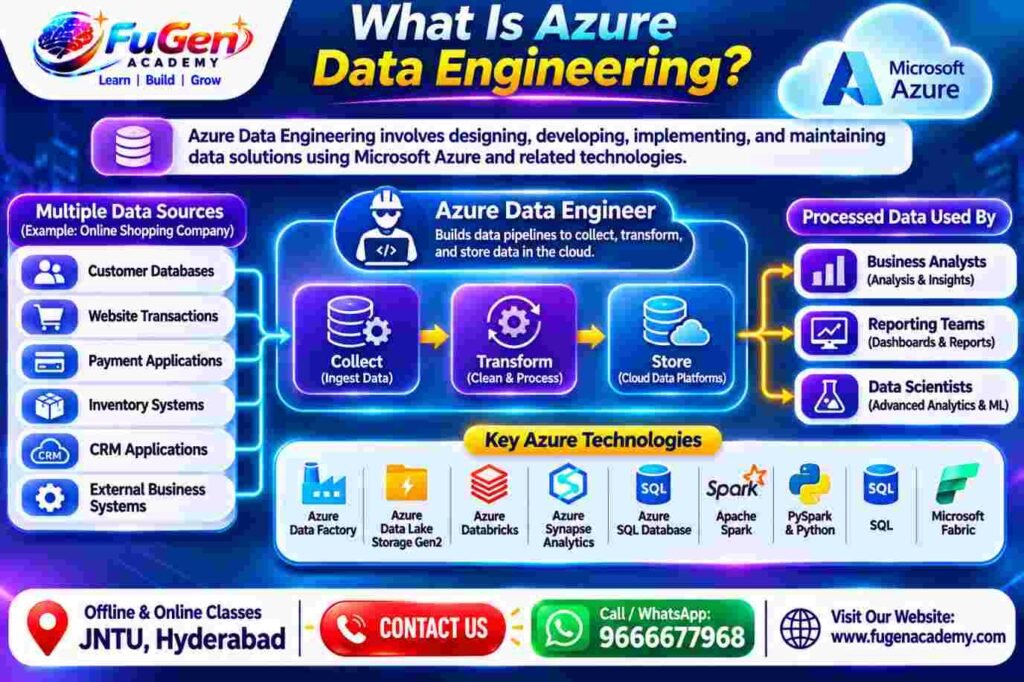
Azure Data Engineering involves designing, developing, implementing, and maintaining data solutions using Microsoft Azure and related technologies.
A data engineer works with different data sources and builds systems that collect, store, process, transform, and deliver information for analytics and business intelligence.
For example, consider an online shopping company that receives thousands of customer orders every day.
The organisation may collect information from:
- Customer databases
- Website transactions
- Payment applications
- Inventory management systems
- CRM applications
- External business systems
An Azure Data Engineer develops data pipelines to collect information from these systems, transforms the data into usable formats, and stores it in appropriate cloud data platforms.
The processed information can then be used by business analysts, reporting teams, and data scientists.
Microsoft Azure provides multiple technologies for developing these solutions, including:
- Azure Data Factory
- Azure Data Lake Storage Gen2
- Azure Databricks
- Azure Synapse Analytics
- Azure SQL Database
- Apache Spark
- PySpark
- Python
- SQL
- Microsoft Fabric
Understanding how these services work together is an important part of becoming a skilled data engineer.
Why Azure Data Engineering Skills Are in Demand
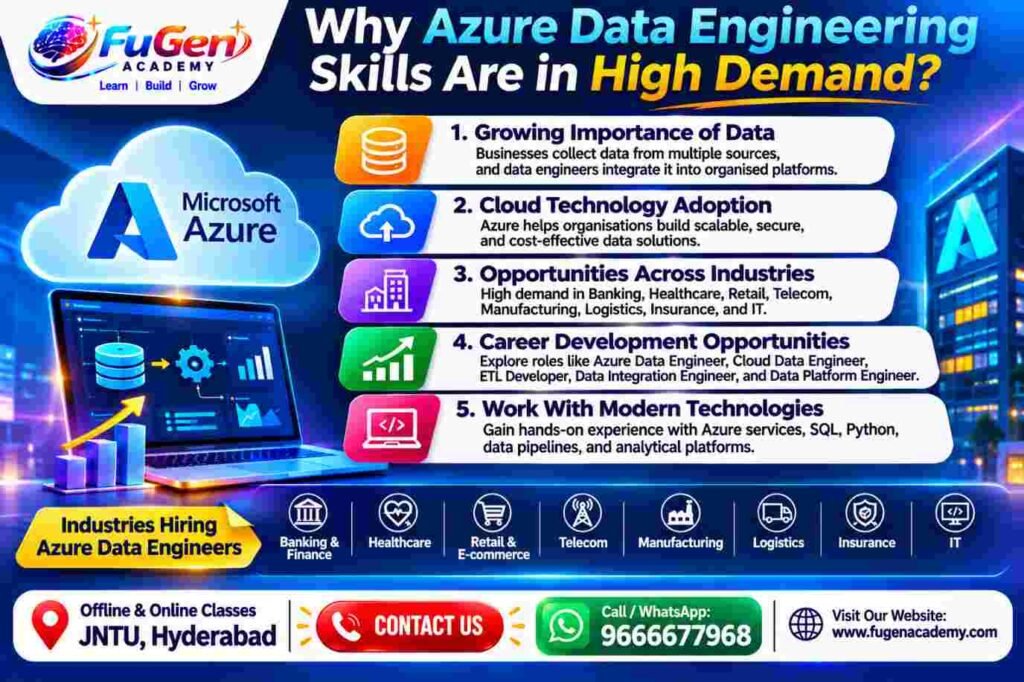
Modern organisations need reliable data infrastructure to support analytics, reporting, automation, and artificial intelligence.
Data engineers help build the infrastructure required to make business data available, consistent, and suitable for analysis.
1. Growing Importance of Data
Businesses collect data from multiple sources, including websites, mobile applications, customer interactions, financial transactions, and enterprise systems.
Data engineers help integrate these sources into organised platforms.
2. Cloud Technology Adoption
Cloud computing allows businesses to develop scalable infrastructure without maintaining all their computing resources in traditional data centres.
Azure offers services that help organisations manage data integration, storage, processing, and analytics.
3. Opportunities Across Industries
Azure Data Engineering knowledge can be relevant in industries such as:
- Banking and financial services
- Healthcare
- Retail and e-commerce
- Telecommunications
- Manufacturing
- Logistics
- Insurance
- Information technology
4. Career Development Opportunities
With technical knowledge and practical experience, professionals may explore roles such as Azure Data Engineer, Cloud Data Engineer, ETL Developer, Data Integration Engineer, and Data Platform Engineer.
Career progression depends on experience, technical expertise, project exposure, and individual performance.
5. Work With Modern Technologies
Azure Data Engineers work with cloud storage, SQL, Python, distributed processing, data pipelines, and analytical platforms.
Learning these technologies helps professionals understand how modern data systems are designed and implemented.
Explore Azure Data Engineering Training at FuGen Academy
Website: https://fugenacademy.com/
Mobile / WhatsApp: 9666677968
Why Choose Azure Data Engineer Offline Training in Hyderabad?
Online learning provides flexibility, but classroom training offers direct interaction with trainers and other learners.
For students who prefer structured learning and face-to-face discussions, Azure Data Engineer Offline Training in Hyderabad can provide an engaging learning environment.
1. Direct Interaction With Trainers
Classroom sessions allow students to ask questions and clarify technical doubts during training.
This can be particularly useful when learning SQL, Python, Azure Data Factory, Databricks, and cloud concepts.
2. Structured Learning Environment
A classroom program follows a planned learning schedule.
Instead of studying different technologies randomly, learners can follow a sequence from fundamentals to advanced topics.
3. Practical Learning Experience
Data engineering requires hands-on practice.
Students should practise creating pipelines, writing SQL queries, processing data, and understanding cloud services rather than relying only on theoretical explanations.
4. Peer Learning
Classroom learning allows students to exchange ideas, discuss technical problems, and learn from different approaches.
5. Doubt Clarification
When students encounter errors in pipelines, SQL queries, or Spark jobs, trainer guidance can help them understand the underlying concepts and troubleshooting methods.
6. Project-Based Learning
Projects help learners understand how multiple Azure services work together.
A practical project can include extracting data from a source, storing it in a data lake, transforming it using Databricks, and preparing datasets for analytics.
Azure Data Engineer Course Curriculum: What Will You Learn?
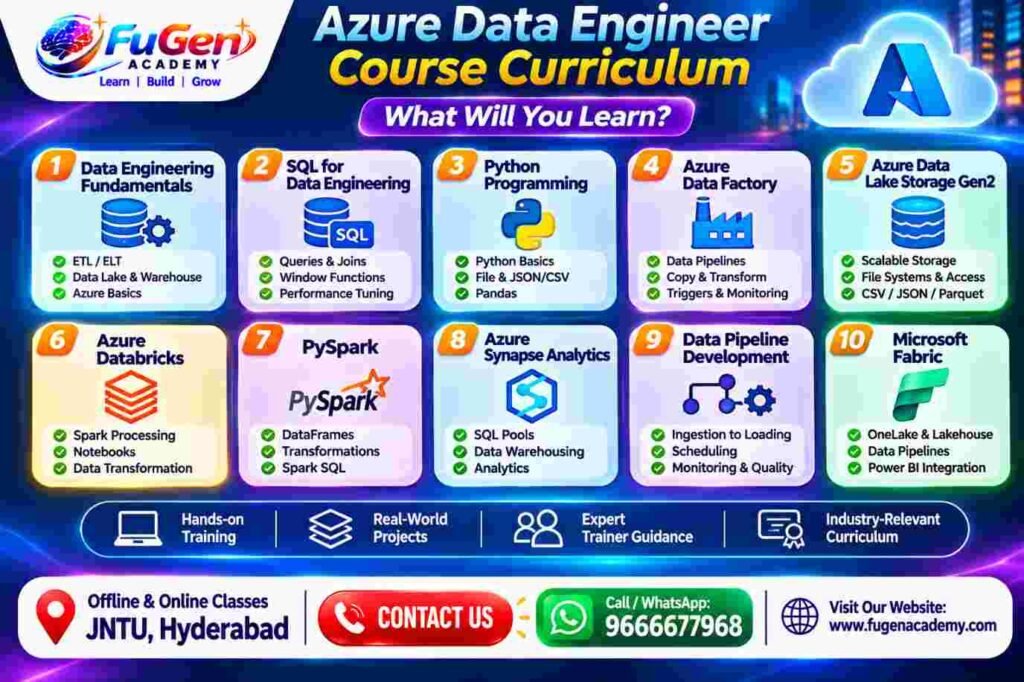
A comprehensive Azure Data Engineering program should include programming fundamentals, database concepts, cloud technologies, data integration, distributed processing, and project implementation.
The following topics represent a suggested learning roadmap.
1. Introduction to Data Engineering
Before working with Azure services, students should understand the fundamentals of data engineering.
Topics include:
- Introduction to data engineering
- Responsibilities of a data engineer
- Structured, semi-structured, and unstructured data
- Data warehouses and data lakes
- ETL and ELT
- Batch processing and stream processing
- Data pipelines and workflows
- Cloud computing fundamentals
- Introduction to Microsoft Azure
These concepts provide the foundation for understanding modern data platforms.
2. SQL for Data Engineering
SQL is one of the most important skills for data engineers.
It is used to retrieve, manipulate, transform, and analyse information stored in databases.
Important topics include:
- Database and table creation
- SELECT statements
- WHERE conditions
- ORDER BY and GROUP BY
- Aggregate functions
- Joins and subqueries
- Common Table Expressions
- Window functions
- Stored procedures
- Views and indexes
- Query optimisation fundamentals
Strong SQL knowledge helps data engineers work efficiently with relational data.
3. Python Programming
Python is widely used in data engineering for automation, integration, and data processing.
Topics include:
- Variables and data types
- Conditional statements
- Loops
- Functions
- Lists, tuples, sets, and dictionaries
- File handling
- Exception handling
- CSV and JSON processing
- Python libraries
- Introduction to Pandas
Python knowledge is useful when developing data processing scripts and automating technical workflows.
4. Azure Data Factory
Azure Data Factory is a cloud-based data integration service used to create and manage data pipelines.
It helps organisations move and transform data from different sources.
Topics include:
- Introduction to Azure Data Factory
- Creating an Azure Data Factory instance
- Understanding the ADF interface
- Linked services
- Datasets
- Integration Runtime
- Copy Data activity
- Pipeline development
- Parameters and variables
- Triggers and scheduling
- Pipeline monitoring
- Error handling
- Incremental data loading
For example, a data engineer can develop a pipeline that extracts customer records from a database and loads them into Azure Data Lake Storage.
Understanding ADF is important for developing cloud-based data integration solutions.
Start Learning Azure Data Engineering With FuGen Academy
Explore training information and course enquiries:
Website: https://fugenacademy.com/
Mobile / WhatsApp: 9666677968
5. Azure Data Lake Storage Gen2
Azure Data Lake Storage Gen2 is designed for scalable storage and analytics workloads.
Data engineers use data lakes to store raw information, transformed datasets, and analytical data.
Topics include:
- Introduction to Azure Data Lake Storage
- Storage accounts
- Containers and file systems
- Folder structures
- Uploading and downloading files
- Access control and permissions
- Storage security
- Connecting Data Factory with Data Lake
- CSV, JSON, and Parquet file formats
Understanding cloud storage is essential when developing modern data engineering architectures.
6. Azure Databricks
Azure Databricks provides a platform for data processing, analytics, and workloads built around Apache Spark.
It is commonly used to process large datasets and develop data transformation workflows.
Topics include:
- Introduction to Azure Databricks
- Workspace creation
- Compute resources
- Notebooks
- Apache Spark fundamentals
- DataFrames
- Reading and writing datasets
- Data transformation
- CSV, JSON, and Parquet
- Spark SQL
- Performance optimisation basics
- Connecting Databricks with Azure Data Lake
Databricks helps data engineers process large volumes of information using distributed computing.
7. PySpark
PySpark is the Python API for Apache Spark.
It enables developers to perform distributed data processing using Python.
Important topics include:
- Spark architecture
- SparkSession
- DataFrames
- DataFrame operations
- Transformations and actions
- Filtering and grouping
- Joins
- Aggregations
- Handling missing values
- Data cleaning
- Spark SQL
- Reading and writing Parquet files
- Optimisation concepts
PySpark is useful for large-scale data transformation and distributed processing.
8. Azure Synapse Analytics
Azure Synapse Analytics is an analytics service that supports data integration, data warehousing, and analytics workloads.
Topics include:
- Introduction to Azure Synapse Analytics
- Synapse workspace
- SQL pools
- Serverless SQL
- Dedicated SQL pools
- Querying data from Azure Data Lake
- Analytical datasets
- Integration with Azure services
Learners should understand the role of analytical platforms and how they support business intelligence.
Note: Azure Synapse is one component of the Azure data ecosystem. Microsoft Fabric is also an important modern analytics platform, so learners should understand both technologies and the relevant use cases.
9. Data Pipeline Development
Building reliable data pipelines is one of the core responsibilities of a data engineer.
A comprehensive learning program should cover:
- Extracting data from multiple sources
- Data ingestion
- Data transformation
- Data validation
- Data loading
- Pipeline scheduling
- Incremental loading
- Error handling
- Pipeline monitoring
- Data quality checks
Students should understand how to develop pipelines that can be monitored, maintained, and improved.
10. Microsoft Fabric Fundamentals
Microsoft Fabric brings together data engineering, data integration, analytics, and related workloads in an integrated platform.
Important introductory topics include:
- Introduction to Microsoft Fabric
- OneLake
- Lakehouse concepts
- Fabric Data Factory
- Data pipelines
- Data engineering notebooks
- SQL analytics
- Integration with Power BI
Microsoft’s official learning resources provide additional information about data engineering skills and training pathways.
Reference: Microsoft Learn – Data Engineer Career Path
Build Your Cloud Data Engineering Skills
Learn about FuGen Academy’s training programs:
Website: https://fugenacademy.com/
Mobile / WhatsApp: 9666677968
Real-Time Azure Data Engineering Projects You Should Practise
Practical projects help learners understand how Azure technologies work together to solve business problems.
A good project should involve data ingestion, storage, transformation, validation, and preparation for analytics.
Project 1: Retail Sales Data Pipeline
Business scenario:
A retail organisation receives sales information from multiple stores and wants to centralise the data for reporting.
Technologies:
- Azure Data Factory
- Azure Data Lake Storage
- Azure Databricks
- PySpark
- SQL
Project activities:
- Extract sales information from different sources.
- Create pipelines using Azure Data Factory.
- Store raw data in Azure Data Lake.
- Clean and transform data using PySpark.
- Organise processed datasets.
- Query the final datasets using SQL.
Learning outcome:
Understand how to develop an end-to-end data pipeline for retail analytics.
Project 2: Customer Data Integration
Business scenario:
An organisation maintains customer information across multiple systems and wants to combine it into a centralised data platform.
Project activities:
- Collect customer information from multiple sources.
- Build data ingestion pipelines.
- Identify duplicate records.
- Handle missing information.
- Transform data using PySpark.
- Store processed information in Azure Data Lake.
- Prepare datasets for reporting.
Learning outcome:
Understand data integration, data cleaning, and transformation techniques.
Project 3: Employee Data Processing
Business scenario:
An organisation wants to process employee information from multiple departments.
Project activities:
- Import employee datasets.
- Develop pipelines using Azure Data Factory.
- Store files in Azure Data Lake.
- Transform datasets using Databricks.
- Apply SQL queries.
- Prepare final datasets for reporting.
Learning outcome:
Understand how Azure services can be combined to develop data processing solutions.
Project 4: Incremental Data Loading
Business scenario:
A company receives new customer records every day and wants to process only newly inserted or updated information.
Project activities:
- Identify new and modified records.
- Develop incremental loading logic.
- Configure pipeline parameters.
- Process data using SQL or PySpark.
- Validate loaded records.
- Monitor pipeline execution.
Learning outcome:
Understand incremental loading and how it can reduce unnecessary data processing.
Get Started With Practical Data Engineering Training
Website: https://fugenacademy.com/
Mobile / WhatsApp: 9666677968
Who Can Join Azure Data Engineer Offline Training in Hyderabad?
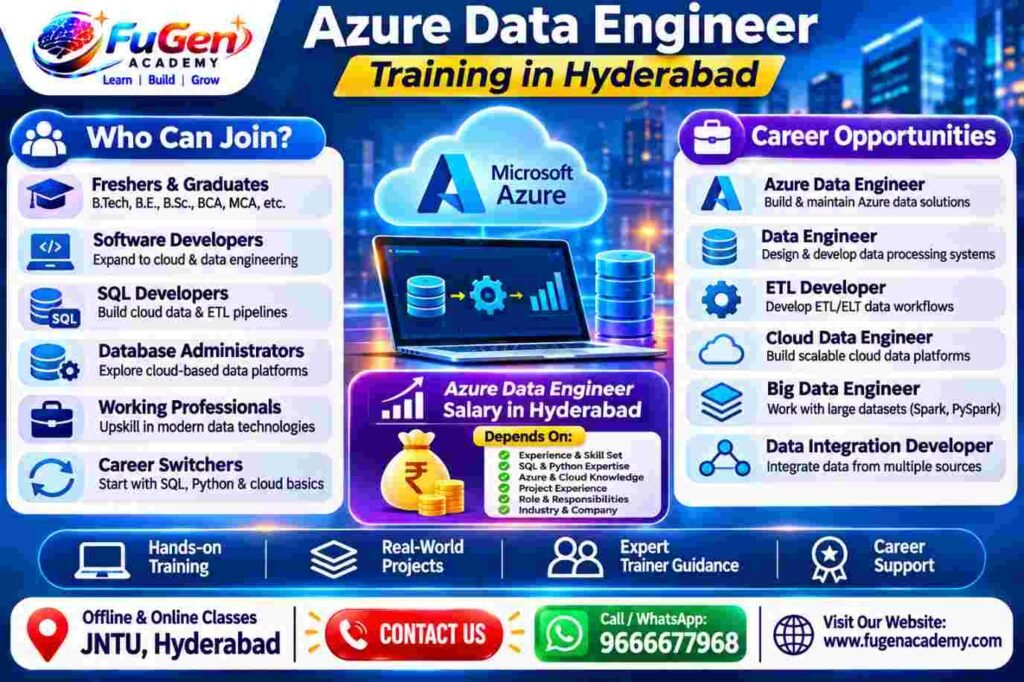
Azure Data Engineering is suitable for individuals interested in programming, databases, cloud computing, and data technologies.
Freshers and Recent Graduates
Students who have completed B.Tech, B.E., B.Sc., BCA, MCA, or other relevant degrees can begin learning data engineering fundamentals.
Basic programming knowledge and logical thinking can be helpful.
Software Developers
Developers who want to expand their knowledge of cloud computing, databases, and data processing can explore Azure Data Engineering.
SQL Developers
Professionals working with SQL databases can strengthen their skills by learning cloud data integration, Spark, and data pipelines.
Database Administrators
Database administrators can explore cloud-based data platforms and modern data processing technologies.
Working Professionals
IT professionals looking to upgrade their technical knowledge may consider Azure Data Engineering as part of their career development.
Career Switchers
Individuals from other technical backgrounds can start with SQL, Python, and cloud fundamentals before progressing towards advanced data engineering topics.
Career Opportunities After Azure Data Engineer Training
After developing technical knowledge and practical experience, learners may explore several data engineering roles.
1. Azure Data Engineer
Develops and maintains data pipelines, cloud storage systems, and data processing solutions using Azure technologies.
2. Data Engineer
Works with different data sources and develops systems to collect, transform, and store data.
3. ETL Developer
Develops extraction, transformation, and loading processes to move data between systems.
4. Cloud Data Engineer
Works with cloud-based data platforms and develops scalable data solutions.
5. Big Data Engineer
Works with large datasets and distributed processing technologies such as Apache Spark.
6. Data Integration Developer
Develops and maintains workflows that integrate data from different applications and databases.
Career opportunities depend on technical knowledge, experience, practical skills, and employer requirements.
Azure Data Engineer Salary in Hyderabad
Salary is an important consideration for professionals planning to enter the data engineering field.
Compensation can vary significantly depending on:
- Previous work experience
- SQL and Python expertise
- Cloud platform knowledge
- Data engineering project experience
- Technical interview performance
- Employer and industry
- Location and responsibilities
Freshers and experienced professionals generally have different salary expectations.
Rather than relying on guaranteed salary figures, candidates should evaluate current job listings and focus on developing the skills required for their target roles.
Practical experience, strong fundamentals, and the ability to explain projects clearly can help candidates prepare for technical interviews.
Take the Next Step Towards Your Data Engineering Career
Connect with FuGen Academy to explore available training options.
Website: https://fugenacademy.com/
Mobile / WhatsApp: 9666677968
Why Choose FuGen Academy for Azure Data Engineer Offline Training in Hyderabad?
Selecting a training institute is an important step in your learning journey.
Before enrolling, students should evaluate the curriculum, practical learning opportunities, trainer support, batch schedule, and project coverage.
FuGen Academy offers training enquiries for learners interested in Azure Data Engineer Offline Training in Hyderabad and cloud technologies.
Industry-Relevant Curriculum
Learn important data engineering technologies such as SQL, Python, Azure Data Factory, Azure Data Lake Storage, Databricks, and PySpark.
Practical Training
Understand how different Azure services work together through exercises and project-based learning.
Trainer Guidance
Ask technical questions, clarify concepts, and improve your understanding of data engineering technologies.
Project-Based Learning
Explore business-oriented project scenarios to understand how data engineering solutions are developed.
Interview Preparation
Practise SQL, Python, Azure concepts, and project-related interview questions.
Career Guidance
Seek guidance on resume preparation, technical interviews, and identifying relevant career opportunities.
Important: Before enrolling, confirm the current batch schedule, course duration, fee structure, curriculum, practical lab access, and any placement assistance directly with the academy.
How to Become an Azure Data Engineer: Step-by-Step Learning Roadmap
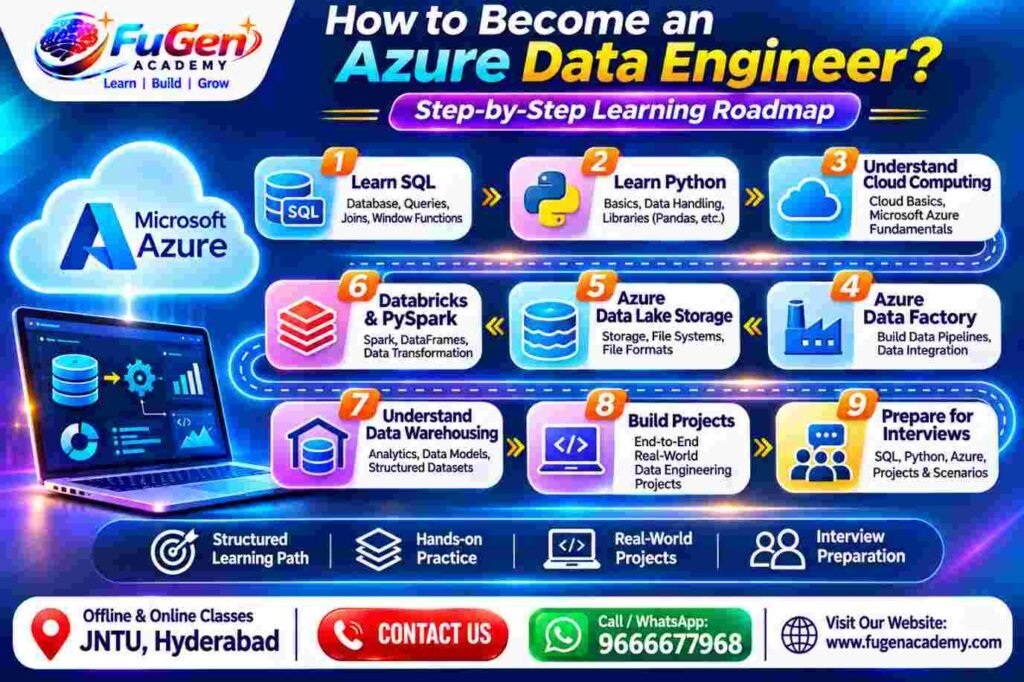
If you are starting from scratch, following a structured learning path can make your learning journey easier.
Step 1: Learn SQL
Start with database fundamentals, SQL queries, joins, subqueries, and window functions.
Step 2: Learn Python
Understand programming fundamentals and practise working with files, data structures, and libraries.
Step 3: Understand Cloud Computing
Learn cloud storage, computing, networking, and Microsoft Azure fundamentals.
Step 4: Learn Azure Data Factory
Practise developing data pipelines and connecting different data sources.
Step 5: Learn Azure Data Lake Storage
Understand cloud storage, file formats, and data organisation.
Step 6: Learn Databricks and PySpark
Develop practical knowledge of distributed processing and data transformation.
Step 7: Understand Data Warehousing
Learn how analytical data platforms work and how structured datasets are prepared.
Step 8: Build Projects
Combine the technologies you have learned to develop end-to-end data engineering projects.
Step 9: Prepare for Interviews
Revise SQL, Python, Azure concepts, project explanations, and technical interview questions.
Following this roadmap can help you gradually develop the skills needed for data engineering opportunities.
Frequently Asked Questions About Azure Data Engineer Offline Training in Hyderabad
1. What is Azure Data Engineer training?
Azure Data Engineer training teaches learners how to collect, store, transform, and manage data using Microsoft Azure services and technologies such as SQL, Python, Azure Data Factory, Databricks, and PySpark.
2. Can freshers join Azure Data Engineer training?
Yes. Freshers can begin learning Azure Data Engineering. Basic programming and database knowledge can make the learning process easier.
3. Is coding required for Azure Data Engineering?
Yes. SQL and Python are important skills. PySpark is also commonly used for distributed data processing.
4. Which tools are covered in Azure Data Engineer training?
A comprehensive course may include Azure Data Factory, Azure Data Lake Storage Gen2, Azure Databricks, PySpark, SQL, Python, and Azure Synapse Analytics.
5. Is offline Azure Data Engineer training available in Hyderabad?
FuGen Academy accepts enquiries from learners interested in classroom-based training. Contact the academy to confirm current offline batch availability, location, and schedule.
6. Can non-IT students learn Azure Data Engineering?
Yes. Learners from non-IT backgrounds can begin with programming, SQL, and cloud fundamentals before moving towards advanced concepts.
7. Do I need prior Azure experience?
Not necessarily. Beginners can start with cloud computing fundamentals and gradually learn Azure services.
8. What projects should I complete during training?
Useful projects include retail sales data processing, customer data integration, employee data processing, and incremental data loading.
9. What is the difference between a Data Analyst and a Data Engineer?
A Data Analyst focuses on analysing information and generating business insights. A Data Engineer builds the pipelines and infrastructure that make data available for analysis.
10. Is Azure Data Engineering a good career option?
It can be a promising career path for individuals interested in cloud computing, programming, databases, and large-scale data processing. Career growth depends on technical skills and practical experience.
11. Which is better: online or offline Azure Data Engineer training?
Online training provides flexibility, while offline training offers face-to-face interaction and classroom discussions. Choose the learning format that suits your preferences.
12. Does Azure Data Engineer training include projects?
Project-based learning is an important part of a comprehensive training program. Ask the academy about the current projects, practical assignments, and lab access.
13. How long does it take to learn Azure Data Engineering?
The duration depends on your existing knowledge, learning schedule, and course curriculum. SQL, Python, cloud fundamentals, and practical projects all require consistent practice.
14. Which certification should I consider?
Microsoft’s certification offerings change over time. Review the official Microsoft Learn certification pages before selecting an exam.
Official resource: https://learn.microsoft.com/en-us/credentials/
15. How can I enrol in Azure Data Engineer training at FuGen Academy?
Contact FuGen Academy through its website or WhatsApp to enquire about current batches, course details, classroom availability, and admission information.
Start Your Azure Data Engineering Journey With FuGen Academy
The data engineering industry offers opportunities for individuals who are willing to learn modern technologies and develop strong technical skills.
Learning Microsoft Azure, SQL, Python, Azure Data Factory, Databricks, and PySpark can help you understand how cloud-based data platforms work.
However, watching tutorials alone may not be enough. Consistent practice, hands-on experience, and the ability to solve technical problems are essential for developing practical knowledge.
If you are searching for Azure Data Engineer Offline Training in Hyderabad, FuGen Academy can be a starting point for exploring a structured learning program.
Build your technical foundation, practise real-world data engineering scenarios, and prepare yourself for opportunities in the cloud technology industry.
Take the Next Step Towards Your Data Engineering Career!
Explore training programs and contact FuGen Academy for details about Azure Data Engineer Offline Training in Hyderabad, classroom batches, curriculum, and admissions.
Website: https://fugenacademy.com/
Mobile / WhatsApp: 9666677968
Start learning today and work towards building your future in Cloud Data Engineering.



One Response