
Are you planning to build a career in Data Engineering? Have you been searching for a technology that can help you work with large amounts of data, build scalable data pipelines, and develop cloud-based data solutions?
Then Databricks is a technology worth exploring.
Today, organisations are working with enormous volumes of data generated from applications, websites, business transactions, customer platforms, and cloud environments. Traditional data processing approaches are not always sufficient to manage these workloads efficiently. This is where modern data engineering platforms such as Databricks and Apache Spark play an important role.
For IT professionals and aspiring Data Engineers in Hyderabad, learning Databricks can be a valuable step towards developing practical big data engineering skills.
If you are searching for a Databricks Online and Offline Training Institute in Hyderabad, FuGen Academy provides job-oriented technology training designed around practical learning, real-world data engineering concepts, and hands-on exercises.
Whether you are a working professional looking to switch jobs or a fresher planning to enter the IT industry, this guide will help you understand Databricks, its importance, the course curriculum, career opportunities, and how to choose the right training institute.
What Is Databricks and Why Is It Important in 2026?
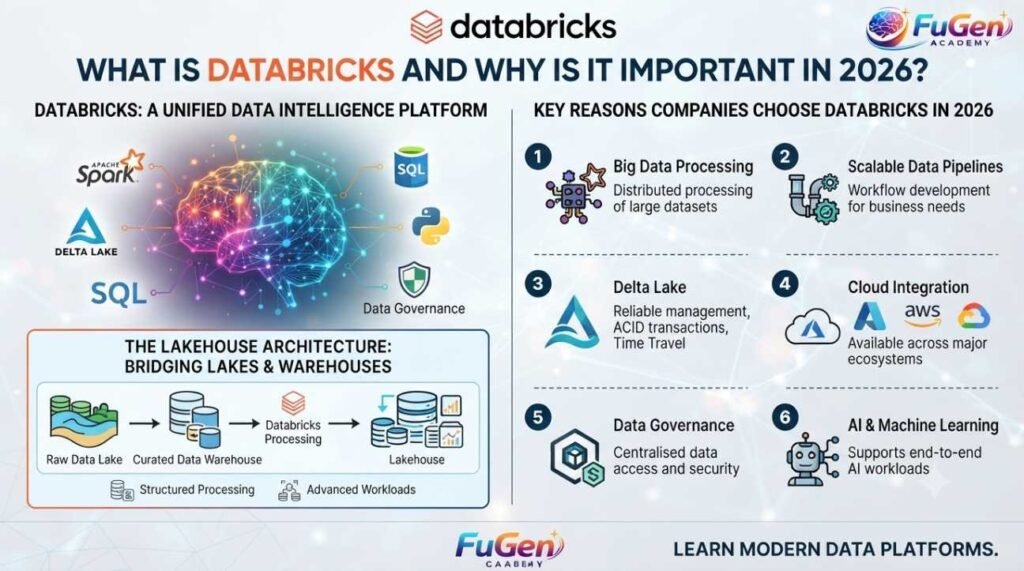
Databricks is a unified Data Intelligence Platform that helps organisations work with data engineering, analytics, machine learning, and AI workloads.
It brings together technologies such as Apache Spark, Delta Lake, SQL, Python, and data governance capabilities to help organisations build and manage modern data platforms.
One of the important concepts behind Databricks is the Lakehouse architecture.
A Lakehouse combines capabilities traditionally associated with data lakes and data warehouses. It allows organisations to store large amounts of data while supporting structured data processing, analytics, and advanced workloads.
For example, imagine an e-commerce company receiving millions of customer transactions every day.
The company needs to:
- Collect data from multiple applications.
- Store information in cloud storage.
- Clean and transform raw data.
- Remove duplicate records.
- Build reporting tables.
- Make processed data available to business analysts.
- Support machine learning and AI applications.
Databricks can help data engineering teams build these workflows using Spark, Delta Lake, SQL, Python, and other platform capabilities.
Why are companies learning towards Databricks?
Some important reasons include:
- Big Data Processing: Apache Spark supports distributed processing of large datasets.
- Scalable Data Pipelines: Engineers can develop data processing workflows for different business requirements.
- Delta Lake: Supports reliable data management with transactions, schema enforcement, and time travel capabilities.
- Cloud Integration: Databricks is available across major cloud ecosystems, including Azure, AWS, and Google Cloud.
- Data Governance: Unity Catalog provides centralised capabilities for managing data access and governance.
- AI and Machine Learning: The platform supports workloads involving machine learning and AI.
Learning Databricks is not simply about understanding a tool. It is about learning how modern data platforms are designed, developed, and maintained.
Why Choose a Databricks Training Institute in Hyderabad?
Hyderabad has developed into one of India’s major IT and technology employment hubs.
Areas such as HITEC City, Madhapur, Gachibowli, Financial District, and Kondapur have a strong presence of technology companies, consulting organisations, product companies, and global capability centres.
Many IT professionals in these locations are exploring Data Engineering, Cloud Computing, Big Data, and AI-related technologies to improve their technical profiles.
However, learning Databricks only through theoretical videos may not be sufficient when you need to work on actual data engineering problems.
A structured training programme can help you understand concepts in the correct order and practise them through practical exercises.
Benefits of classroom training
- Direct interaction with trainers.
- Immediate clarification of technical doubts.
- Practical demonstrations during sessions.
- Better opportunities for group discussions.
- Classroom discipline and regular learning schedules.
Benefits of online Databricks training
- Attend sessions from home or office.
- Suitable for working professionals with busy schedules.
- Save travelling time.
- Learn from anywhere in India.
- Revise concepts using available learning materials and session recordings, where provided.
At FuGen Academy, students can enquire about both online and offline Databricks training options in Hyderabad.
Looking for Databricks training in Hyderabad?
FuGen Academy offers technology training with a focus on practical understanding and career-oriented learning.
- WhatsApp / Contact: 9666677968
- Website: https://fugenacademy.com
- Location: JNTU Hyderabad
What Will You Learn in the FuGen Academy Databricks Course?
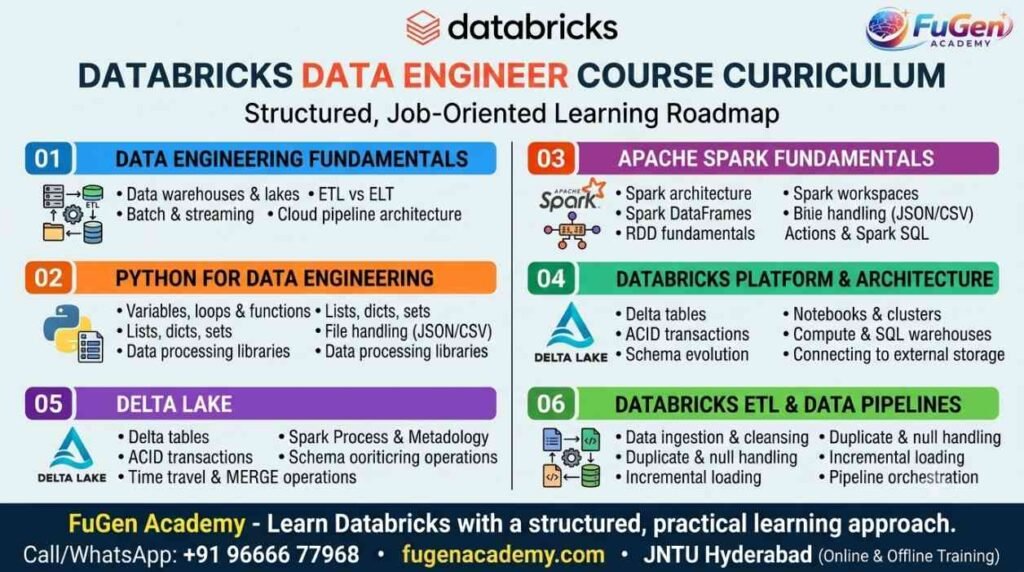
A good Databricks Data Engineer course should not begin directly with advanced pipeline development.
Students should first understand the fundamentals of data engineering, Python, SQL, and distributed processing.
The following topics form a structured learning roadmap for Databricks.
Module 1: Data Engineering Fundamentals
Before developing pipelines, students should understand how data moves between different systems.
Topics include:
- Introduction to Data Engineering.
- OLTP and OLAP concepts.
- Data warehouses and data lakes.
- ETL and ELT architecture.
- Batch processing and streaming.
- Structured and semi-structured data.
- Data pipeline architecture.
- Introduction to cloud-based data engineering.
Module 2: Python for Data Engineering
Python is widely used for developing data engineering applications.
Students should understand:
- Python fundamentals.
- Variables and data types.
- Conditional statements and loops.
- Functions and modules.
- Lists, dictionaries, tuples, and sets.
- Exception handling.
- File handling.
- Working with JSON and CSV files.
- Introduction to Python libraries used in data processing.
Module 3: Apache Spark Fundamentals
Apache Spark is one of the most important technologies to learn when working with Databricks.
Students will understand:
- Introduction to Apache Spark.
- Spark architecture.
- Driver and executor concepts.
- Cluster computing.
- RDD fundamentals.
- Spark DataFrames.
- Transformations and actions.
- Lazy evaluation.
- Narrow and wide transformations.
- Spark SQL.
- Joins and aggregations.
- Partitioning and caching.
- Performance considerations.
The objective is to understand how Spark processes data across multiple machines instead of depending only on traditional single-machine processing.
Module 4: Databricks Platform and Architecture
This module introduces students to the Databricks environment.
Topics include:
- Introduction to the Databricks Lakehouse Platform.
- Workspace architecture.
- Compute resources.
- Notebooks.
- Clusters and compute management.
- SQL Warehouses.
- Databricks workspace navigation.
- Working with Python and SQL notebooks.
- Importing and managing data.
- Connecting to external storage.
Students should understand how different components work together when building a data engineering solution.
Module 5: Delta Lake
Delta Lake is an important part of modern Lakehouse architecture.
Topics include:
- Introduction to Delta Lake.
- Delta tables.
- ACID transactions.
- Schema enforcement.
- Schema evolution.
- Time Travel.
- MERGE operations.
- UPDATE and DELETE operations.
- OPTIMIZE.
- VACUUM.
- Managing historical data.
- Reliable data processing.
For example, students can practise maintaining customer records when new transactions arrive every day and only the changed records need to be updated.
Module 6: Databricks ETL and Data Pipelines
This is one of the most important areas for Data Engineer roles.
Topics include:
- Reading CSV, JSON, and Parquet files.
- Data ingestion.
- Data cleansing.
- Data transformation.
- Handling duplicate records.
- Null value management.
- Data validation.
- Incremental data loading.
- Building reusable transformations.
- Batch data processing.
- Pipeline orchestration.
Students should understand how to move data from raw sources into clean, business-ready tables.
FuGen Academy – Learn Databricks with a structured, practical learning approach.
For online and offline training enquiries:
- WhatsApp: 9666677968
- Website: https://fugenacademy.com
- Training location: JNTU Hyderabad
Advanced Databricks Concepts You Should Learn
Understanding the basics is important, but professional Data Engineers also need to understand how to manage, secure, monitor, and optimise production workloads.
Module 7: Lakeflow and Workflow Management
Databricks provides workflow capabilities for orchestrating data engineering workloads.
Students can learn:
- Lakeflow Jobs.
- Job creation and configuration.
- Task dependencies.
- Scheduling.
- Parameterised jobs.
- Monitoring job execution.
- Failure handling.
- Retry strategies.
- Pipeline dependencies.
These concepts help engineers automate repetitive data processing activities.
Module 8: Unity Catalog and Data Governance
Data security is an important responsibility for modern Data Engineering teams.
Unity Catalog provides governance capabilities for managing data assets and access.
Topics include:
- Introduction to Unity Catalog.
- Metastore concepts.
- Catalogs and schemas.
- Tables and views.
- Access control.
- Permissions and privileges.
- Data discovery.
- Data lineage.
- Data governance fundamentals.
Students should understand why data access needs to be controlled and how organisations manage permissions across different users and teams.
Module 9: Performance Optimisation
A pipeline that works correctly is not necessarily an efficient pipeline.
Professional engineers must also understand how to improve execution performance and manage resource consumption.
Topics include:
- Spark execution plans.
- Data partitioning.
- Repartition and coalesce.
- Caching and persistence.
- Shuffle operations.
- Broadcast joins.
- Skewed data handling.
- File optimisation.
- Query performance.
- Compute resource management.
Practical exercises should demonstrate how different transformation approaches can affect execution time and resource usage.
Module 10: Cloud Integration
Databricks works with different cloud ecosystems.
Students can explore integration concepts involving:
Azure:
- Azure Data Lake Storage Gen2.
- Azure Data Factory.
- Azure Databricks.
- Microsoft Entra-based access concepts.
AWS:
- Amazon S3.
- IAM fundamentals.
- Cloud storage integration.
- Data ingestion patterns.
Google Cloud:
- Google Cloud Storage.
- Cloud-based data processing.
- Integration architecture concepts.
The exact cloud implementation depends on the environment and course lab availability.
Module 11: Git and CI/CD Fundamentals
Modern data engineering teams also follow software development practices.
Important concepts include:
- Git fundamentals.
- Version control.
- Branching and merging.
- Collaborative development.
- Deployment practices.
- Databricks Git folders.
- Declarative Automation Bundles.
- Development and production environments.
These skills help students understand how code moves from development into managed environments.
Hands-On Databricks Projects for Practical Experience
One of the biggest mistakes students make while learning a new technology is concentrating only on definitions and interview questions.
In an actual Data Engineer role, you may be asked to develop an ETL pipeline, troubleshoot failed jobs, process millions of records, or optimise an existing transformation.
That is why practical projects should be an important part of Databricks training.
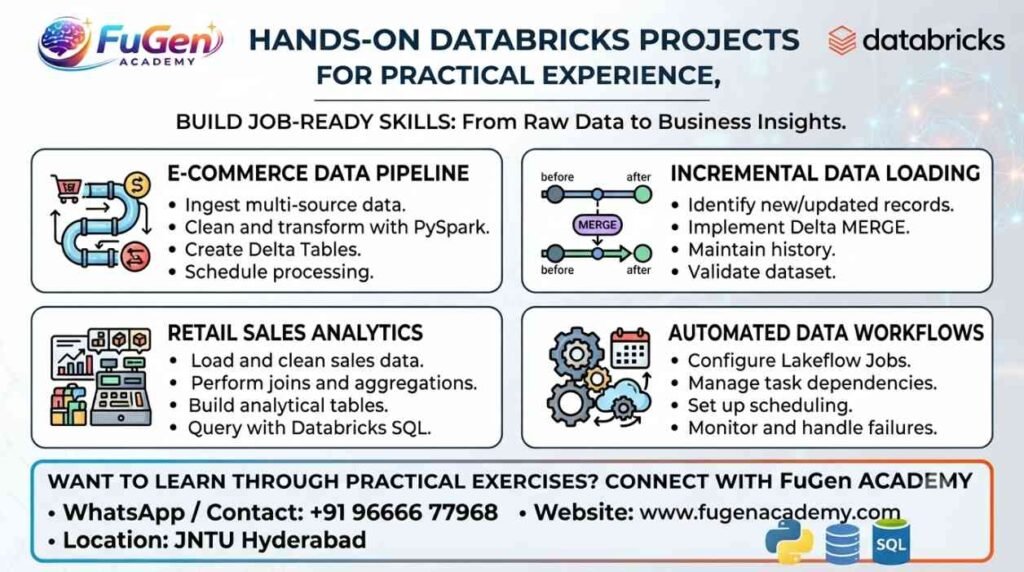
Here are some project ideas suitable for learning.
Project 1: E-Commerce Data Engineering Pipeline
Business scenario:
An e-commerce company receives customer, product, and order information from multiple sources.
Your responsibility is to build a pipeline that processes the incoming data.
Activities:
- Ingest customer and transaction files.
- Store raw data.
- Perform data cleansing.
- Remove duplicate records.
- Create Delta tables.
- Apply transformations using PySpark.
- Develop reporting tables.
- Schedule the processing workflow.
Project 2: Incremental Data Loading
Business scenario:
A company receives updated customer records every day. Reloading the entire dataset is not always necessary.
Activities:
- Understand incremental loading.
- Identify new and updated records.
- Implement Delta MERGE operations.
- Maintain historical information.
- Validate the final dataset.
Project 3: Retail Sales Analytics
Business scenario:
A retail organisation wants to analyse sales across products, stores, and locations.
Activities:
- Load sales data.
- Clean and transform datasets.
- Perform joins and aggregations.
- Create analytical tables.
- Use Databricks SQL for reporting queries.
Project 4: Automated Data Pipeline
Business scenario:
A business wants its data processing activities to run automatically every day.
Activities:
- Develop transformation notebooks.
- Configure Lakeflow Jobs.
- Schedule tasks.
- Configure dependencies.
- Monitor execution.
- Handle failures.
The purpose of these projects is to help learners understand how technical concepts are used to solve business problems.
Want to learn through practical Databricks exercises?
Connect with FuGen Academy to enquire about course curriculum, available batches, online and classroom training.
- WhatsApp: 9666677968
- Website: https://fugenacademy.com
- Location: JNTU Hyderabad
Who Should Join Databricks Online or Offline Training?
Databricks training can be useful for different categories of learners.
Working IT Professionals
If you are currently working with SQL, Oracle, PostgreSQL, Python, or ETL tools, Databricks can help you expand your Data Engineering knowledge.
Professionals with experience in traditional data warehouses may find it useful to understand distributed processing and Lakehouse architecture.
SQL Developers
SQL developers who want to move towards modern Data Engineering can learn Spark SQL, PySpark, Delta Lake, and pipeline development.
Azure Data Engineers
Professionals working with Azure Data Factory, ADLS Gen2, and Azure cloud services can explore Azure Databricks as another important component of their data engineering skill set.
Freshers and Graduates
Freshers interested in entering the Data Engineering domain can start by learning Python, SQL, database fundamentals, and Apache Spark before progressing towards Databricks.
Data Analysts
Data Analysts who want to understand large-scale data processing and develop stronger technical skills can explore Databricks SQL and its Lakehouse environment.
Career Opportunities After Learning Databricks
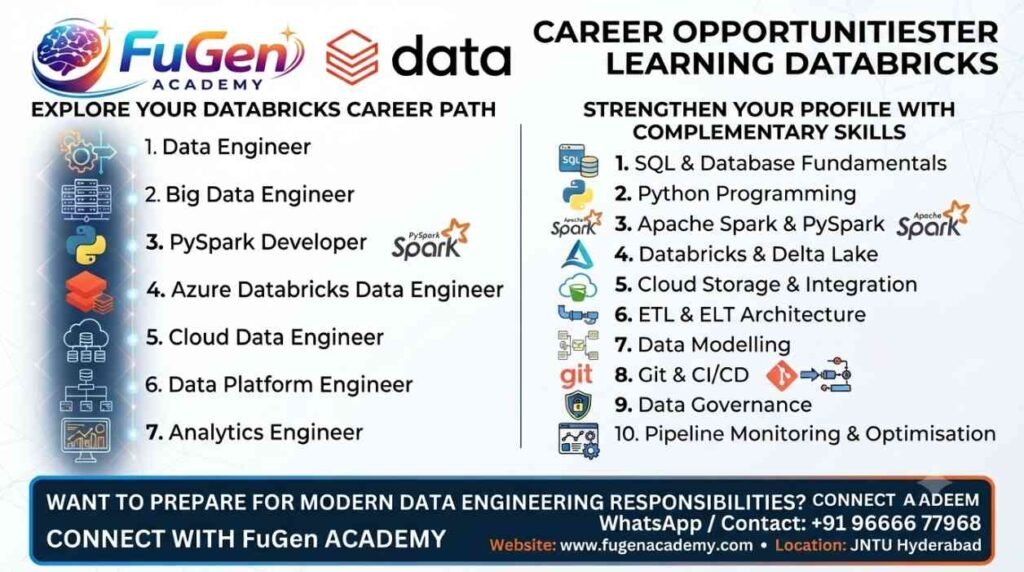
Databricks is a platform skill that supports several technical career paths.
Depending on your existing experience, technical knowledge, and practical project exposure, you can explore roles such as:
- Data Engineer.
- Big Data Engineer.
- PySpark Developer.
- Azure Databricks Data Engineer.
- Cloud Data Engineer.
- Data Platform Engineer.
- Analytics Engineer.
However, learning Databricks alone does not guarantee a job. Employers generally evaluate a combination of technical fundamentals, practical experience, problem-solving ability, project knowledge, and communication skills.
Skills that can strengthen your Data Engineer profile
Consider developing these complementary skills:
- SQL and database fundamentals.
- Python programming.
- Apache Spark and PySpark.
- Databricks and Delta Lake.
- Cloud storage and integration.
- ETL and ELT architecture.
- Data modelling.
- Git and CI/CD.
- Data governance.
- Pipeline monitoring and optimisation.
A combination of these skills can help you prepare for modern Data Engineering responsibilities.
Databricks Certification Preparation
Certification can help demonstrate your understanding of the Databricks platform.
One recognised certification path is the Databricks Certified Data Engineer Associate.
The official certification syllabus covers areas including:
- Databricks Intelligence Platform.
- Data ingestion and loading.
- Data transformation and modelling.
- Lakeflow Jobs.
- CI/CD.
- Troubleshooting and optimisation.
- Governance and security.
The current official exam guide should always be checked before beginning certification preparation because examination topics can change.
Students should focus on practical platform knowledge instead of depending only on memorised questions.
FuGen Academy can help learners build the foundational knowledge and practical skills needed for their learning journey. Certification registration and examination fees are separate unless explicitly included in a course offer.
Why Consider FuGen Academy for Databricks Training in Hyderabad?
Choosing the right institute is an important decision because the quality of learning can influence how confidently you apply your skills.
At FuGen Academy, the focus is on helping students understand technology through structured training and practical learning.
What learners should look for at FuGen Academy
- Online and Offline Learning Options
Students can enquire about online sessions or classroom-based learning at the JNTU Hyderabad location.
- Practical-Oriented Training
Data Engineering concepts become easier to understand when learners practise transformations, queries, data ingestion, and pipeline development.
- Industry-Relevant Curriculum
A good learning plan should cover Python, Spark, Databricks, Delta Lake, SQL, ETL, and data engineering fundamentals.
- Doubt Clarification
Students should have opportunities to clarify technical doubts and understand why a particular solution works.
- Project-Based Learning
Working on practical scenarios helps students connect individual concepts to complete data engineering workflows.
- Interview Preparation
Students can prepare by understanding commonly asked technical questions, explaining project architecture, and practising SQL and Python problems.
- Career Guidance
Learners can work towards improving their resumes, project explanations, and interview readiness.
Before enrolling, we encourage students to enquire about the current syllabus, batch timings, trainer details, lab facilities, and available support.
Contact FuGen Academy
If you are looking for a Databricks online and offline training institute in Hyderabad, connect with our team to discuss the available training options.
FuGen Academy
- Location: JNTU Hyderabad, Telangana.
- WhatsApp / Mobile: 9666677968.
- Website: https://fugenacademy.com.
- Training: Online and Offline.
You can contact us to enquire about course details and upcoming batches.
How to Choose the Best Databricks Training Institute in Hyderabad?
Before joining any institute, compare the learning experience rather than selecting a course based only on advertisements or fees.
Here are some important questions to ask:
| Evaluation criteria | What to check |
| Trainer experience | Ask about practical Databricks project experience |
| Course syllabus | Check Spark, PySpark, Delta Lake and SQL coverage |
| Practical labs | Confirm whether students can practise independently |
| Cloud environment | Understand the lab setup and additional cloud costs |
| Projects | Ask for project descriptions and learning outcomes |
| Batch timings | Check weekday and weekend availability |
| Session recordings | Confirm whether recordings are provided |
| Interview preparation | Check the technical preparation support |
| Placement assistance | Understand exactly what assistance is offered |
| Course fees | Ask about inclusions and additional charges |
A genuine training institute should be comfortable explaining its syllabus, teaching methodology, available facilities, and limitations.
Do not make your decision based only on promises of high salaries or guaranteed placements.
Instead, choose a programme that gives you enough opportunities to understand concepts, practise independently, and build confidence.
Databricks Learning Roadmap for Beginners
If you are completely new to Databricks, follow a logical learning sequence.
Step 1: Learn SQL
Understand joins, subqueries, CTEs, window functions, aggregations, and analytical queries.
Step 2: Learn Python
Focus on programming fundamentals, functions, data structures, file handling, and exception handling.
Step 3: Understand Apache Spark
Learn Spark architecture, DataFrames, transformations, actions, and Spark SQL.
Step 4: Start with Databricks
Explore the workspace, notebooks, compute resources, and data processing environment.
Step 5: Learn Delta Lake
Practise Delta tables, MERGE, schema evolution, and Time Travel.
Step 6: Build Data Pipelines
Create batch processing workflows and automate tasks using Lakeflow Jobs.
Step 7: Learn Governance and Optimisation
Understand Unity Catalog, access controls, performance tuning, and monitoring.
Step 8: Complete Projects
Build end-to-end projects and practise explaining the business problem, architecture, transformations, and results.
Following this sequence can make learning more organised and help you develop a strong foundation.
Final Thoughts: Start Your Data Engineering Journey with Databricks
Data Engineering continues to evolve as organisations invest in cloud platforms, big data processing, analytics, and AI-driven applications.
Databricks is an important technology within this ecosystem because it brings together data engineering, analytics, and AI capabilities.
But remember, becoming a good Data Engineer is not about learning one platform or collecting certificates. It is about understanding data, solving problems, writing efficient code, and building reliable pipelines.
If you are based in Hyderabad or anywhere in India and want to learn Databricks through structured online or offline training, FuGen Academy is an option worth exploring.
Start with SQL and Python, understand Apache Spark, practise Delta Lake, and gradually move towards developing complete data engineering projects.
Your career journey starts with the skills you build today.
Take the first step towards learning Databricks with FuGen Academy.
Contact Details:
- FuGen Academy
- WhatsApp: 9666677968
- Website: https://fugenacademy.com
- Location: JNTU Hyderabad
- Training Mode: Online and Offline
Contact us to enquire about the Databricks course curriculum and available batches.
Frequently Asked Questions (FAQs)
1. Which is the best Databricks training institute in Hyderabad?
The best institute depends on trainer expertise, practical training, course curriculum, project exposure, and student support. FuGen Academy offers online and offline technology training options in Hyderabad. Students can contact the academy to enquire about the current Databricks training programme.
2. Does FuGen Academy provide online Databricks training?
Yes. Students can enquire about online Databricks training options through FuGen Academy. Online learning is useful for working professionals and students who cannot regularly travel to the training centre.
3. Does FuGen Academy provide offline Databricks training in Hyderabad?
FuGen Academy offers classroom-based training options at its JNTU Hyderabad location. Contact the academy at 9666677968 to confirm the latest classroom batch schedule and availability.
4. What is the duration of a Databricks course?
The duration depends on the syllabus, batch schedule, and the learner’s existing knowledge of Python, SQL, and Apache Spark. Contact FuGen Academy for the current course duration and batch details.
5. Is Databricks suitable for freshers?
Yes. Freshers can learn Databricks, but they should first understand SQL, Python, database fundamentals, and Apache Spark. A structured learning roadmap makes it easier to understand the platform.
6. Can SQL developers learn Databricks?
Absolutely. SQL developers already understand important concepts such as joins, aggregations, filtering, and data manipulation. They can extend these skills by learning Spark SQL, PySpark, Delta Lake, and distributed data processing.
7. Do I need Python knowledge before joining Databricks training?
Basic Python knowledge is helpful, especially when working with PySpark. Beginners can start with Python fundamentals before moving into advanced Spark programming.
8. What are the important topics covered in Databricks training?
A comprehensive Databricks learning programme should cover Apache Spark, PySpark, Spark SQL, Databricks architecture, Delta Lake, ETL pipelines, Lakeflow Jobs, Unity Catalog, cloud integration, Git, and performance optimisation.
9. Is Apache Spark necessary for Databricks?
Understanding Apache Spark is highly beneficial because Spark is a core technology used for distributed data processing within Databricks. Knowledge of DataFrames, transformations, actions, and Spark SQL is particularly useful.
10. What is the difference between Databricks and Apache Spark?
Apache Spark is a distributed data processing engine. Databricks is a broader data intelligence platform that provides a managed environment and additional capabilities for data engineering, analytics, governance, and AI.
11. What is Delta Lake in Databricks?
Delta Lake is a storage framework that brings reliability features such as ACID transactions, schema enforcement, schema evolution, and Time Travel to data lake workloads.
12. Can I learn Databricks without cloud experience?
Yes. You can begin by learning SQL, Python, Spark, and Databricks fundamentals. However, understanding cloud storage, permissions, and cloud architecture will help you develop stronger practical skills.
13. What projects should I complete after Databricks training?
You can practise e-commerce ETL pipelines, retail sales analytics, incremental data loading, customer data processing, and automated batch processing workflows.
14. Does Databricks offer certification?
Yes. Databricks offers professional certifications, including the Databricks Certified Data Engineer Associate and Data Engineer Professional. Check the official Databricks certification website for the latest exam requirements.
15. What career opportunities are available after learning Databricks?
Depending on your experience and complementary technical skills, you can explore roles such as Data Engineer, Big Data Engineer, PySpark Developer, Cloud Data Engineer, and Data Platform Engineer.
16. Is Databricks useful for Azure Data Engineers?
Yes. Azure Databricks is commonly used in modern Azure data engineering architectures. Knowledge of Azure Data Factory, ADLS Gen2, SQL, Python, and Azure Databricks can help professionals understand end-to-end cloud data solutions.
17. What is the fee for Databricks training at FuGen Academy?
Course fees may depend on the training mode, batch, duration, and course inclusions. Contact FuGen Academy directly for the latest fee details and available offers.
18. Where is FuGen Academy located in Hyderabad?
FuGen Academy is located at JNTU Hyderabad. Students interested in offline training can contact 9666677968 for location details and classroom batch availability.
19. Are session recordings available for online Databricks classes?
Recording availability depends on the current batch arrangements. Students should confirm recording access and revision support with the academy before enrolling.
20. How can I join Databricks training at FuGen Academy?
You can contact FuGen Academy through WhatsApp at 9666677968 or visit https://fugenacademy.com to enquire about the Databricks syllabus, online and offline training, upcoming batches, and enrolment process.
About FuGen Academy
FuGen Academy is a technology training institute based in JNTU Hyderabad, Telangana, offering technology-focused learning programmes for students and working professionals. The academy focuses on practical learning and career-oriented technology education.
Website: https://fugenacademy.com
WhatsApp: 9666677968
Location: JNTU Hyderabad, Telangana, India.