
Have you noticed how quickly Generative AI has become part of everyday work?
A few years ago, artificial intelligence often sounded like something limited to research labs and large technology companies. Today, people use AI to write emails, summarize documents, create images, analyze information, generate code, and automate repetitive tasks.
This change has also created a new learning opportunity for students and IT professionals.
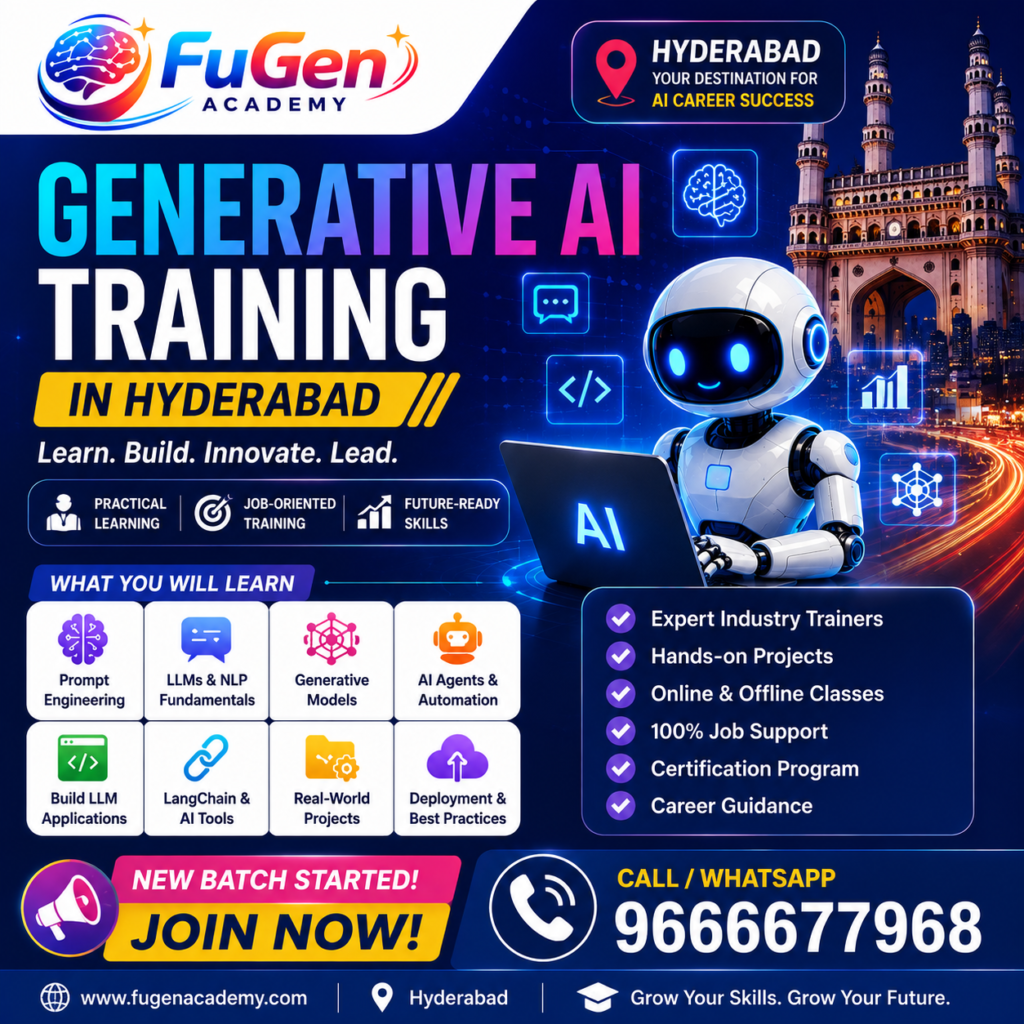
If you are searching for Generative AI Training in Hyderabad, you will find plenty of courses, institutes, workshops, and online programs. The challenge is not finding a course. The real challenge is finding training that teaches you how to understand AI and use it to solve practical problems.
That distinction matters.
Knowing how to ask an AI tool a question is useful, but it is only the beginning. If you want to develop professional-level skills, you need to understand how large language models work, how applications communicate with AI models, how information can be retrieved from documents, how AI agents work, and how to build and test useful applications.
This guide explains what you should look for when learning Generative AI in Hyderabad and how you can build your skills step by step.
What Exactly Is Generative AI?
Generative AI refers to AI systems that can create new content based on the instructions they receive.
That content could be:
- Text
- Code
- Images
- Audio
- Video
- Summaries
- Reports
- Conversations
- Business documents
A simple example is an AI assistant that receives a question and produces a written answer.
But there is much more happening behind the scenes.
Modern Generative AI applications can connect AI models with company documents, databases, APIs, software applications, and other tools. This allows businesses to create systems that can do much more than generate text.
For example, imagine an employee wants to find information from hundreds of company policy documents.
Instead of opening files one by one, the employee could ask a question in normal language. An AI application could search the relevant information and provide an answer based on those documents.
Building something like this requires more than prompt writing. It requires an understanding of AI models, data, retrieval, application development, and testing.
That is where proper Generative AI training becomes valuable.
Why Are More People Learning Generative AI?
The popularity of Generative AI is not simply because AI tools are interesting.
Businesses are looking at practical ways to use AI.
A marketing team may use AI to organize research.
A software team may use AI to assist with coding and documentation.
A customer-service team may use an AI assistant to help answer frequently asked questions.
A company may build an internal knowledge assistant that allows employees to search company information using natural language.
These examples show why AI skills are becoming relevant across different industries.
For professionals, learning Generative AI does not always mean changing careers completely. In many cases, it can be added to the skills they already have.
A Python developer can learn to build LLM-powered applications.
A data engineer can explore RAG and AI data pipelines.
A tester can learn how AI can support software testing.
A business analyst can use AI for research and information analysis.
The combination of existing experience and new AI skills can be particularly useful.
Why Consider Generative AI Training in Hyderabad?
Hyderabad has a large technology community and a strong presence of IT companies, startups, and technology professionals.
That makes the city a natural place for people interested in learning modern technologies.
Students can find classroom-based training as well as online learning options. Working professionals can often choose schedules that fit around their jobs.
However, the location of an institute should not be your only consideration.
The quality of the training matters much more.
Before joining any Generative AI course in Hyderabad, look carefully at the syllabus, trainers, projects, practical sessions, and support provided after the classes.
A flashy advertisement may attract your attention, but a well-structured curriculum is what will actually help you learn.
Who Can Learn Generative AI?
One common misconception is that Generative AI is only for experienced programmers.
That is not true.
Different people can approach the subject from different starting points.
Students
Students who are beginning their technology careers can start with basic programming and AI concepts.
They do not need to understand everything at once.
A sensible approach is to learn the fundamentals first and then gradually move toward application development.
Software Developers
Developers are in a strong position to explore Generative AI because they already understand programming and software development.
They can move into areas such as:
- LLM APIs
- AI application development
- RAG
- Embeddings
- Vector databases
- AI agents
- AI-powered automation
Data Professionals
Data professionals can combine their existing knowledge with Generative AI.
For example, they can explore how AI applications retrieve information from structured and unstructured data.
They can also learn how embeddings, vector search, and retrieval systems work.
Testing Professionals
AI is also influencing software testing.
Testing professionals can explore AI-assisted test generation, documentation, test analysis, and automation.
The important thing is to understand that AI can assist testing, but human review and proper validation remain necessary.
Business and Non-Technical Professionals
You don’t necessarily need to become an AI developer to benefit from Generative AI.
Business professionals can use AI for research, summarization, content preparation, brainstorming, document analysis, and workflow improvement.
The learning path should simply match the person’s role and objective.
What Should You Learn in a Generative AI Course?
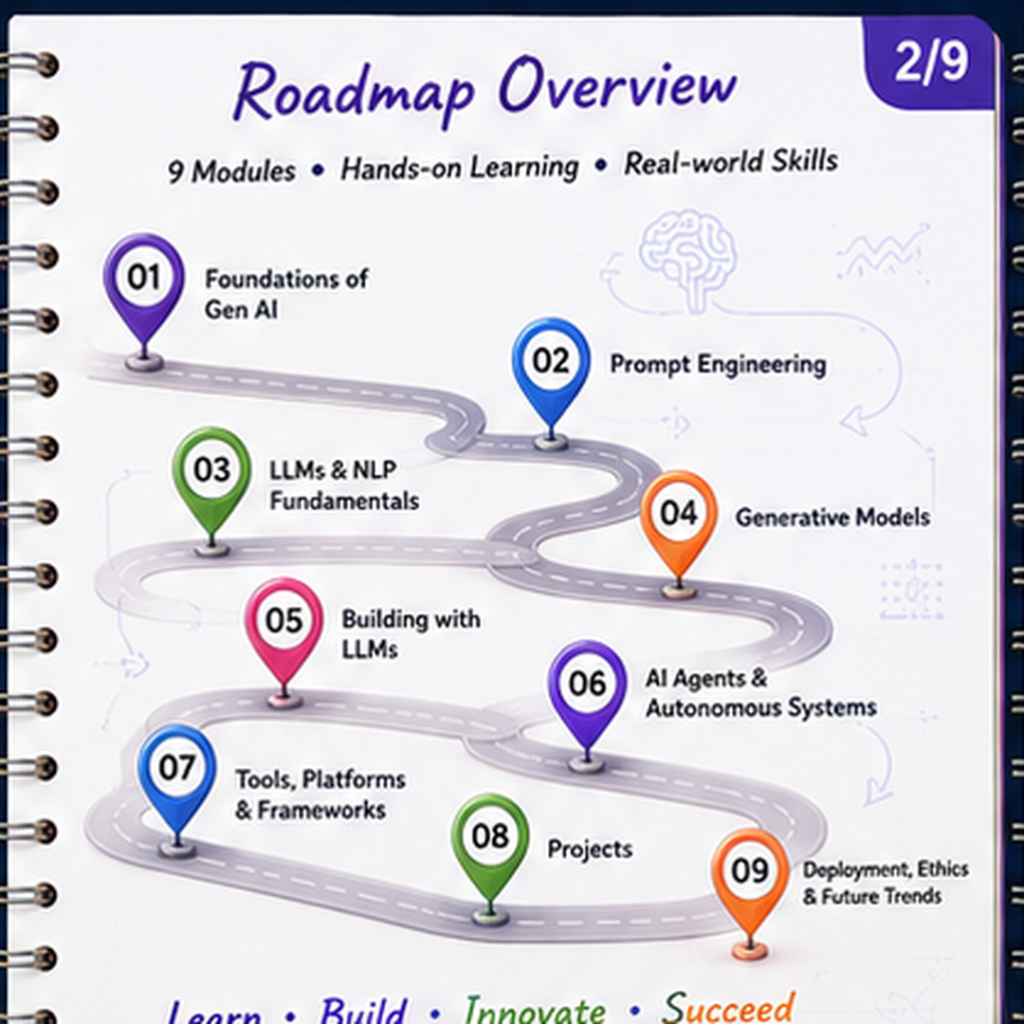
A good course should have a logical progression.
You should not be thrown directly into advanced AI frameworks without understanding the basics.
Here is a practical learning path.
1. AI and Generative AI Fundamentals
Start by understanding the basic terminology.
You should know the difference between:
- Artificial Intelligence
- Machine Learning
- Deep Learning
- Generative AI
- Large Language Models
- Natural Language Processing
You should also understand what an AI model does and why AI systems sometimes produce incorrect answers.
These fundamentals give you a foundation for everything that follows.
2. Python Basics
If your goal is to build Generative AI applications, Python can be extremely useful.
You don’t necessarily need advanced programming knowledge on day one.
Start with:
- Variables
- Data types
- Conditions
- Loops
- Functions
- Lists
- Dictionaries
- File handling
- Exceptions
- APIs
- JSON
Once you are comfortable with these concepts, working with AI APIs becomes much easier.
3. Large Language Models
Large Language Models are at the heart of many modern Generative AI applications.
A beginner should understand concepts such as:
- Tokens
- Context
- Model inference
- Model limitations
- Prompt and response structure
- Hallucinations
- Model selection
You don’t have to become an AI researcher to understand these concepts.
The goal is to know what is happening well enough to build useful applications.
4. Prompt Engineering
Prompt engineering is often the first topic people encounter when they start learning Generative AI.
A good prompt gives the AI enough information to understand what you want.
Compare these two instructions:
Write a blog about AI.
with:
Write a beginner-friendly article explaining how Generative AI can help software developers. Use simple language, five headings, practical examples, and a short conclusion.
The second instruction gives the model much more direction.
Good prompting involves providing context, specifying the task, defining constraints, and describing the desired output.
But don’t make the mistake of thinking that prompt engineering alone is an AI career.
It is one useful skill within a much larger field.
5. Working With AI APIs
This is where your learning starts becoming more practical.
Instead of using an AI tool manually, you can connect an AI model to your own application.
You can learn how to:
- Send requests
- Receive responses
- Work with JSON
- Handle errors
- Manage API keys
- Process model output
- Connect AI with other applications
For a developer, this opens the door to building real AI-powered software.
6. Embeddings
Embeddings can seem confusing when you first encounter them.
The basic idea is easier to understand with an example.
Suppose you have these two sentences:
How can I reset my password?
and:
What should I do if I forgot my login password?
They use different words, but their meaning is similar.
Embeddings help represent the meaning of information in a numerical form so that applications can find semantically related content.
This becomes particularly useful when building search and retrieval systems.
7. Retrieval-Augmented Generation
RAG is one of the most useful concepts for people learning practical Generative AI.
RAG stands for Retrieval-Augmented Generation.
Imagine a company has thousands of internal documents.
An AI model by itself may not know the latest information in those documents.
A RAG application can search the company’s knowledge base, find relevant content, and provide that information to the AI model before generating an answer.
A simplified workflow looks like this:
Documents → Processing → Embeddings → Search → Relevant Information → AI Model → Response
This approach can be used for applications such as:
- Document assistants
- Knowledge-base chatbots
- Customer support systems
- Internal company search
- Research assistants
Learning RAG is therefore an important step for anyone interested in AI application development.
8. Vector Databases
When learning RAG, you will probably encounter vector databases.
They help applications store and search embeddings efficiently.
Depending on the course, you may work with technologies such as FAISS, Chroma, Pinecone, or other vector-search solutions.
Don’t focus only on memorizing the names.
Understand the workflow.
You should know:
- How information is divided into useful sections.
- How those sections are converted into embeddings.
- How embeddings are stored.
- How relevant information is retrieved.
- How retrieved information is provided to the AI model.
Once you understand that process, switching between technologies becomes easier.
9. AI Agents
AI agents are another area attracting attention.
A basic chatbot usually responds to a user’s message.
An agent-based application can be designed to perform multiple actions.
For example, imagine an employee asks:
Find the latest sales report, summarize it, and prepare three key observations.
An AI workflow could potentially:
- Identify the required information.
- Search a data source.
- Retrieve the relevant report.
- Analyze the information.
- Produce a summary.
- Return the results.
The exact architecture depends on the application, but the important concept is that AI can be connected with tools and workflows.
10. Projects and Practical Assignments
This is one area you should never ignore when comparing training institutes.
Ask yourself:
What will I actually build?
Watching someone else build an AI application is different from building one yourself.
A practical Generative AI course might include projects such as:
Project 1: AI Chatbot
Build a conversational application using an LLM.
Project 2: Document Assistant
Allow users to upload documents and ask questions about their content.
Project 3: RAG Application
Create a knowledge-based assistant that retrieves relevant information before generating an answer.
Project 4: AI Agent
Build an application that can use tools to complete a multi-step task.
Projects should not simply be copied from a trainer’s screen.
You should understand the architecture and make your own changes.
Why Projects Matter for Your Career
Suppose an interviewer asks:
Have you worked with RAG?
You can answer:
Yes.
But that answer doesn’t tell the interviewer much.
A stronger response would be:
I built a document-question answering application. I processed the documents, created embeddings, stored them for similarity search, retrieved relevant sections, and passed the retrieved context to the language model. I also tested cases where the retrieved information was not relevant.
Now you have something concrete to discuss.
This is why projects can be more valuable than simply collecting certificates.
How to Choose the Right Generative AI Institute in Hyderabad
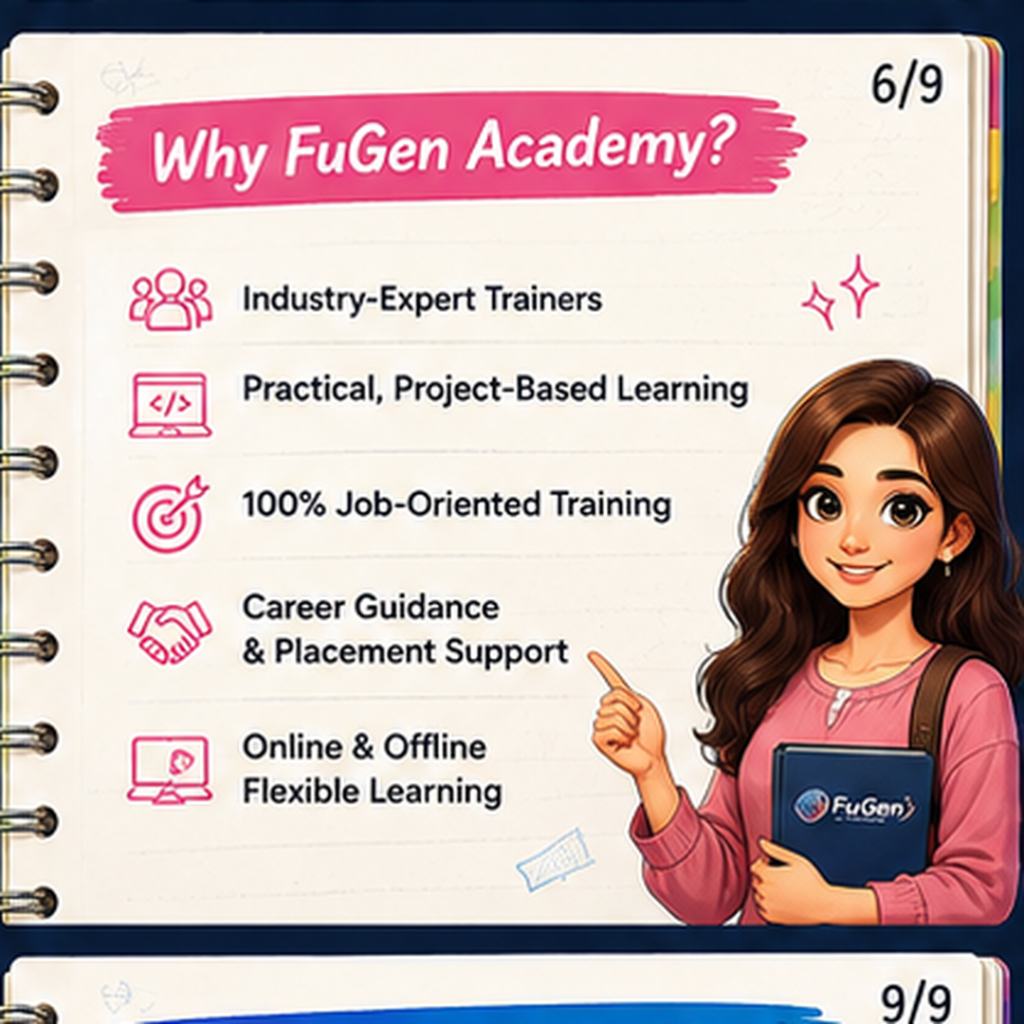
There are many options available, so take your time before enrolling.
Look at the Curriculum
Don’t choose a course just because it says “Generative AI.”
Read the actual syllabus.
Check whether it covers the concepts you want to learn.
Ask About Practical Training
Find out how much of the course involves hands-on work.
A course that is mostly presentations may not be enough if your goal is development.
Meet the Trainer
Attend a demo class if possible.
Pay attention to whether the trainer explains concepts clearly.
Good teaching is not about using complicated terminology.
It is about making difficult ideas understandable.
Ask About Projects
Ask for examples of projects students build.
If possible, ask whether you will build the projects yourself.
Understand Career Support
If an institute mentions placement assistance, ask what that actually includes.
For example:
- Resume support
- Interview preparation
- Mock interviews
- Job updates
- Portfolio guidance
Avoid assuming that placement assistance automatically means a guaranteed job.
Compare Online and Offline Training
Choose the format that suits your learning style.
Offline classes can provide direct interaction.
Online classes can provide flexibility.
Neither format is automatically better.
The quality of teaching and your consistency matter more.
Common Mistakes People Make While Learning Generative AI
Learning a new technology can be exciting, but beginners often make a few avoidable mistakes.
Mistake 1: Trying to Learn Every AI Tool
There are constantly new frameworks, models, and tools.
You don’t need to learn all of them.
Focus on the fundamentals first.
Mistake 2: Learning Only Theory
Reading about RAG is not the same as building a RAG application.
Practice is essential.
Mistake 3: Depending Completely on AI-Generated Code
AI can help you write code, but you should understand what the code does.
If something breaks, you need enough knowledge to debug it.
Mistake 4: Ignoring Programming
If you want a technical AI career, programming remains important.
AI tools can help developers, but they do not eliminate the need to understand software development.
Mistake 5: Expecting a Job Immediately
Learning Generative AI is not a shortcut.
You need to develop skills, build projects, practice interviews, and understand the fundamentals.
Give yourself time.
How to Build Your Generative AI Portfolio
Once you have learned the basics, create a small portfolio.
You don’t need twenty projects.
Three strong projects can be more useful than ten unfinished ones.
For every project, document:
- What problem you were solving
- Why you selected the approach
- Which technologies you used
- How the application works
- What problems you faced
- How you tested it
- What you would improve
This shows that you understand your work.
A Simple Learning Roadmap
If you are completely new to Generative AI, don’t try to learn everything in one week.
A gradual approach is better.
Stage 1: Foundation
Learn:
- AI basics
- Generative AI concepts
- Python fundamentals
- LLM basics
Stage 2: AI Application Skills
Learn:
- Prompt engineering
- APIs
- Structured outputs
- Embeddings
Stage 3: Advanced Application Concepts
Learn:
- RAG
- Vector databases
- AI agents
- Tool integration
Stage 4: Projects
Build applications that solve realistic problems.
Stage 5: Career Preparation
Prepare:
- Resume
- GitHub portfolio
- Project explanations
- Technical interview questions
- Mock interviews
This approach gives you a clearer path than randomly jumping between AI tutorials.
Can Beginners Learn Generative AI?
Yes, but your starting point matters.
If you have never programmed before, begin with basic programming and gradually move into AI.
If you already know Python, you can progress faster.
If you are an experienced software developer, you can focus more heavily on AI application architecture and advanced topics.
There is no reason to compare your learning speed with someone else’s.
The important thing is to build a strong foundation.
Is Generative AI a Good Career Option?
Generative AI is creating new opportunities, but it is important to have realistic expectations.
Learning one AI tool does not make someone an AI engineer.
A strong technical profile can combine:
Programming + AI Fundamentals + LLMs + RAG + Application Development + Projects + Problem Solving
These skills can be applied across different roles and industries.
Also remember that the AI ecosystem changes quickly.
A framework you learn today may be updated tomorrow.
That is why understanding the underlying concepts is so important.
Tools will change.
Good engineering principles will continue to matter.
How Fugen Academy Can Help You Learn Generative AI
For learners searching for Generative AI Training in Hyderabad, Fugen Academy can be considered as one of the options for structured technology training.
The most useful training experience should go beyond explaining AI terminology. Learners should get opportunities to understand concepts, practice them, work on projects, ask questions, and gradually become comfortable building AI applications.
Before enrolling, students should review the current course curriculum, class schedule, training format, project structure, trainer profile, and career-support details.
A demo class can also help you understand whether the teaching approach is right for you.
The goal should not simply be to complete a course.
The goal should be to leave the course with skills you can actually use.
Frequently Asked Questions
What is Generative AI training?
Generative AI training is a structured learning program that teaches how AI models generate content and how developers and professionals can use these models to build practical applications.
Is Generative AI training suitable for freshers?
Yes. Freshers can begin with AI fundamentals and programming basics before moving toward LLM applications, RAG, agents, and projects.
Do I need coding experience?
It depends on your goal. Non-technical users can learn how to use AI tools, while people targeting technical AI development roles should develop programming skills, particularly Python.
What is the difference between Generative AI and traditional AI?
Traditional AI systems are often designed to analyze information, classify data, make predictions, or perform specific tasks. Generative AI focuses on producing new content such as text, code, images, audio, or other outputs.
What is RAG?
RAG stands for Retrieval-Augmented Generation. It allows an AI application to retrieve relevant information from an external knowledge source and use that information when generating a response.
How important are projects?
Projects are extremely useful because they allow you to demonstrate practical skills. They also give you real examples to discuss during interviews.
Should I learn prompt engineering?
Yes, prompt engineering is useful. However, if your goal is a technical AI career, don’t stop there. Learn programming, APIs, LLM concepts, RAG, agents, and application development as well.
Can working professionals learn Generative AI?
Yes. Working professionals can learn Generative AI as an additional skill and apply it to their existing domain.
Final Thoughts
Learning Generative AI is not about chasing every new AI tool that appears online.
It is about understanding how the technology works and learning how to use it to solve real problems.
If you are looking for Generative AI Training in Hyderabad, take some time before choosing a course. Compare the syllabus, trainers, practical sessions, projects, learning format, and career support.
Ask yourself one simple question:
“What will I be able to build after completing this course?”
The answer can tell you more about the quality of a training program than a long list of promotional claims.
Start with the basics. Practice regularly. Build projects. Learn from your mistakes. Keep improving.
Generative AI is still developing, and there will always be something new to learn. The professionals who build a strong foundation and continue adapting will be in a better position to take advantage of the opportunities ahead.
If your goal is to develop practical Generative AI skills in Hyderabad, explore the available training options, attend a demo session, compare the curriculum, and choose a learning path that matches your career goals.
Start learning today, build practical AI projects, and take the next step toward an AI-focused career with Fugen Academy.
Start Your Generative AI Career with Fugen Academy
Looking for Generative AI Training in Hyderabad that focuses on practical learning and career preparation? Fugen Academy provides structured, job-oriented training designed to help students and working professionals build relevant AI skills.
With practical projects, trainer guidance, interview preparation, and 100% placement assistance, learners can prepare for the opportunities available in the growing AI industry.
Don’t choose a course only because of its syllabus. Attend a demo, understand the training approach, ask questions, and choose a learning path that matches your career goals.
Take the next step with Fugen Academy and start building your Generative AI skills today.
Contact Fugen Academy
Ready to start your Generative AI journey in Hyderabad?
Join Fugen Academy for career-focused IT training with practical learning, real-time projects, interview preparation, and 100% placement assistance.
📍 Fugen Academy
Kukatpally, Hyderabad, Telangana – 500090
📞 Call / WhatsApp: +91 96666 77968
💻 Training Mode: Online & Offline
🎓 Free Demo: Available
💼 Placement Assistance: 100%
🌐 Website: https://fugenacademy.com/
Whether you are a fresher, student, or working professional, connect with Fugen Academy to learn more about the latest Generative AI training, upcoming batches, course curriculum, and demo sessions.
Start learning. Build practical skills. Prepare for your AI career with Fugen Academy.